
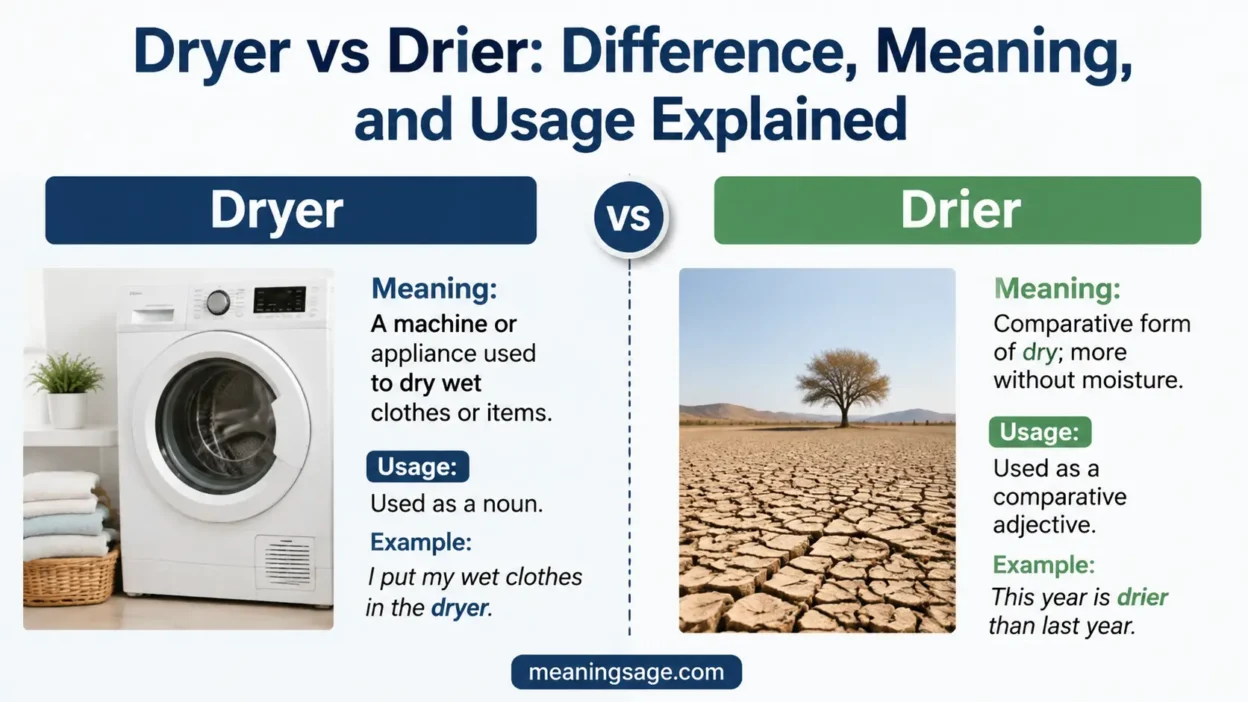
Dryer vs Drier look almost identical, but they are used in different situations. The main difference is that dryer usually refers to a machine or a person/thing that makes something dry, while drier is the comparative form of the adjective dry, meaning “more dry than something else.”
Although these words are pronounced the same in many varieties of American English, their meanings and grammatical roles are different. Choosing the correct one depends on whether you are comparing dryness or talking about something that dries objects.
Quick Answer
Dryer is usually a noun that means a device used for drying something, such as a clothes dryer or hair dryer. It can also describe something that dries faster. Drier is an adjective meaning “more dry,” used when comparing two things, such as “This towel is drier than that one.”
What Does Dryer Mean?
The word dryer most commonly refers to a machine or device that removes moisture from something.
Examples include:
- a clothes dryer that dries laundry
- a hair dryer that dries hair
- a hand dryer in a public restroom
In these cases, dryer is a noun.
Examples:
- I put my clothes in the dryer after washing them.
- She used a hair dryer before leaving the house.
- The bathroom has an automatic hand dryer.
The word can also describe something that causes drying.
Example:
- This fan makes the room dryer by removing moisture.
However, this use is less common than the noun meaning.
What Does Drier Mean?
Drier is the comparative form of the adjective dry.
It means that something contains less moisture than something else.
Examples:
- Arizona is drier than Florida.
- This towel feels drier than the one on the floor.
- The air becomes drier during winter.
The pattern is:
dry → drier → driest
Examples:
- The desert is dry.
- The desert is drier than the forest.
- The desert is one of the driest places on Earth.
Key Difference Between Dryer and Drier
| Word | Meaning | Part of Speech | Example |
|---|---|---|---|
| Dryer | A machine or something that dries | Noun (usually) | The dryer finished the laundry. |
| Drier | More dry; having less moisture | Adjective | This shirt is drier now. |
The easiest way to remember the difference:
- If you mean a machine, use dryer.
- If you are comparing dryness, use drier.
Dryer as a Noun
The most common use of dryer is for appliances.
Common examples:
Clothes Dryer
A clothes dryer uses heat and air movement to remove water from clothing.
Example:
- The dryer stopped working yesterday.
Hair Dryer
A hair dryer blows warm air to dry hair.
Example:
- I need my hair dryer before my appointment.
Hand Dryer
A hand dryer dries wet hands in public places.
Example:
- The restaurant replaced paper towels with hand dryers.
Drier as a Comparison Word
Drier compares the amount of moisture between two things.
Examples:
- Today feels drier than yesterday.
- This climate is drier than the coastal region.
- The second towel is drier because it was left outside longer.
A common mistake is using dryer when the sentence needs a comparison.
Incorrect:
- This towel is dryer than the other one.
Better:
- This towel is drier than the other one.
Is Dryer Ever an Adjective?
Yes, but it is less common.
Sometimes dryer can describe something that creates a drying effect.
Example:
- A dryer climate can affect your skin.
However, in everyday American English, people usually use drier when comparing levels of dryness.
Pronunciation of Dryer and Drier
In most American English accents, dryer and drier are pronounced the same.
Pronunciation:
dryer / drier: DRY-er
Because they sound alike, the difference must be understood from context and spelling.
Common Mistakes
Mistake 1: Using Dryer for Comparisons
Incorrect:
- The air today is dryer than yesterday.
Correct:
- The air today is drier than yesterday.
Why:
The sentence compares two levels of dryness, so the adjective form drier is needed.
Mistake 2: Using Drier for a Machine
Incorrect:
- I put my clothes in the drier.
Correct:
- I put my clothes in the dryer.
Why:
A machine that dries clothes is called a dryer.
Dryer vs Drier in Everyday Examples
| Situation | Correct Word | Example |
|---|---|---|
| Laundry machine | Dryer | The dryer is full of clothes. |
| Comparing weather | Drier | Nevada is drier than Oregon. |
| Hair appliance | Dryer | My hair dryer broke. |
| Comparing towels | Drier | This towel is drier now. |
| Describing climate | Drier | The region has drier winters. |
Which Word Should You Use?
Use dryer when you are talking about:
- an appliance
- a drying device
- something that dries another object
Use drier when you are talking about:
- a comparison
- lower moisture levels
- something becoming less wet
A quick test:
Ask yourself: “Am I talking about a thing that dries something, or am I comparing how dry something is?”
If it is a thing → dryer
If it is a comparison → drier
Related Words: Dry, Dryer, and Driest
These words follow a common adjective pattern:
- Dry = having little moisture
- Drier = more dry than another thing
- Driest = the most dry
Examples:
- The desert is dry.
- The desert is drier than the grassland.
- The desert is among the driest environments.
Frequently Asked Questions
Is dryer and drier the same word?
No. They sound similar, but they have different meanings. Dryer usually refers to a machine, while drier means “more dry.”
Is a clothes dryer spelled dryer or drier?
A clothes machine is spelled dryer. A clothes dryer removes moisture from clothing.
Why do dryer and drier sound the same?
In many American English accents, both words have the same pronunciation, which makes them easy to confuse.
Is drier a real word?
Yes. Drier is the correct comparative form of dry.
Example:
“This room is drier than the basement.”
Should I write hair dryer or hair drier?
The correct term is hair dryer because it refers to a device that dries hair.
What is the opposite of drier?
The opposite of drier is usually wetter because it means having more moisture.
Conclusion
Dryer and drier differ by meaning, even though they often sound the same. Dryer usually names a device that removes moisture, while drier compares two things and means “more dry.” Remembering whether you are talking about a drying tool or comparing dryness will help you choose the correct word every time.


