
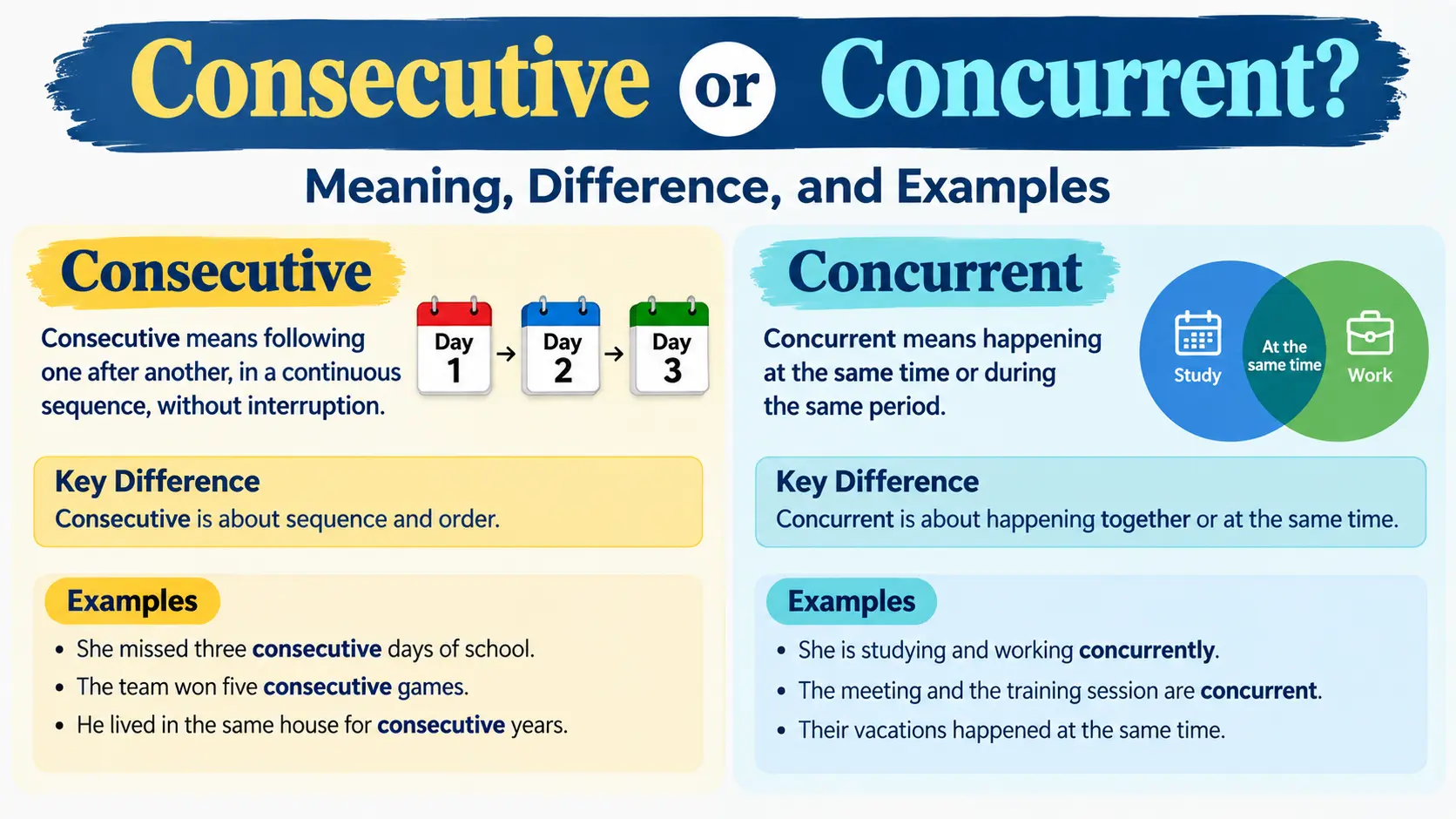
The words Consecutive or Concurrent are often confused because both describe how events, periods, or actions relate to time. However, they describe two very different patterns.
Consecutive means following one after another without interruption.
Concurrent means happening at the same time or overlapping in time.
For example, if a team wins three games on three successive days, the games are consecutive. If two meetings happen at the same time, they are concurrent.
Understanding this difference is especially useful in everyday writing, business, education, law, sports, and scheduling.
Quick Answer: Consecutive vs. Concurrent
- Consecutive: Following one after another in uninterrupted sequence.
- Concurrent: Happening at the same time or during overlapping periods.
Examples
- She worked for five consecutive days.
- The company held two concurrent meetings.
A simple way to remember the difference is:
Consecutive = one after another.
Concurrent = at the same time.
What Does Consecutive Mean?
Consecutive is an adjective meaning following one another in a continuous or uninterrupted sequence.
When things happen consecutively, there is an established order, and each event follows the previous one.
For example:
He worked seven consecutive days.
This means he worked for seven days in a row.
Examples of Consecutive
- The team won five consecutive games.
- She attended class for three consecutive days.
- It rained for four consecutive hours.
- He received awards in two consecutive years.
- The company reported growth for six consecutive quarters.
- They missed three consecutive appointments.
In each example, the events or periods occur one after another.
Consecutive Does Not Necessarily Mean Immediately
An important point is that consecutive means uninterrupted sequence, but the exact time interval depends on the context.
For example:
The company reported profits in three consecutive years.
This means the years follow one another without a year being skipped.
Similarly:
She won three consecutive championships.
This means she won the championship three times in successive instances or seasons.
The word describes sequence, not necessarily events occurring without even a moment between them.
What Does Concurrent Mean?
Concurrent is an adjective meaning happening or existing at the same time.
Two or more events, activities, conditions, or periods are concurrent when they overlap in time.
For example:
The company held two concurrent meetings.
This means both meetings were taking place during the same period.
Examples of Concurrent
- The conference offered several concurrent sessions.
- She had two concurrent projects.
- The two investigations were concurrent.
- The students took concurrent courses.
- The company ran several concurrent campaigns.
- The two events were scheduled to occur concurrently.
The key idea is overlap in time.
Consecutive vs. Concurrent: Key Difference
The easiest way to distinguish the words is to think about a timeline.
| Word | Meaning | Time Relationship | Example |
|---|---|---|---|
| Consecutive | Following one after another | Sequential | Five consecutive days |
| Concurrent | Happening at the same time | Overlapping | Two concurrent meetings |
Consecutive
Event A → Event B → Event C
The events happen one after another.
Concurrent
Event A + Event B + Event C
The events happen during the same period.
This is the central difference between the two words.
Consecutive vs. Concurrent Examples
Let’s compare them directly.
Example 1: Work
Consecutive:
She worked five consecutive days.
She worked on Day 1, Day 2, Day 3, Day 4, and Day 5.
Concurrent:
She had two concurrent jobs.
She held both jobs during the same period.
Example 2: Classes
Consecutive:
The course lasted three consecutive weeks.
The weeks followed one another.
Concurrent:
He took two concurrent courses.
He took both courses during the same period.
Example 3: Events
Consecutive:
The team played three consecutive games.
The games occurred one after another.
Concurrent:
The tournament featured several concurrent matches.
Multiple matches were taking place at the same time.
Consecutive vs. Concurrent in Scheduling
These words are particularly useful when discussing schedules.
Suppose a company schedules three training sessions.
If the sessions take place Monday, Tuesday, and Wednesday, they are consecutive sessions.
If three sessions take place at different locations at the same time, they are concurrent sessions.
Consecutive Schedule
- Monday: Session 1
- Tuesday: Session 2
- Wednesday: Session 3
The sessions occur one after another.
Concurrent Schedule
- 10:00 a.m.: Session 1
- 10:00 a.m.: Session 2
- 10:00 a.m.: Session 3
The sessions occur at the same time.
This distinction can make schedules much clearer.
Consecutive vs. Concurrent in Business
Both words are common in professional and business writing.
Consecutive
Use consecutive when describing results or events that continue in sequence.
Examples:
- The company experienced growth for four consecutive quarters.
- Sales increased for three consecutive months.
- The employee worked ten consecutive days.
Concurrent
Use concurrent when describing projects, responsibilities, or activities that occur at the same time.
Examples:
- The team managed three concurrent projects.
- The company launched two concurrent campaigns.
- She was responsible for several concurrent initiatives.
Consecutive vs. Concurrent in Law
Both words can have specialized meanings in legal contexts.
Consecutive sentences are sentences that are served one after another.
For example, if two sentences are imposed consecutively, the second begins after the first is completed.
Concurrent sentences are served during the same period.
For example, if two sentences are concurrent, they overlap rather than being served one after another.
The basic distinction remains the same:
- Consecutive = one after another
- Concurrent = at the same time
Legal terminology can involve additional rules depending on the jurisdiction and circumstances, but the basic language distinction is straightforward.
Consecutive vs. Concurrent in Sports
Sports writers frequently use consecutive to describe repeated achievements.
Examples:
- The team won four consecutive games.
- The player scored in three consecutive matches.
- The club won two consecutive championships.
Concurrent is more likely to describe events happening simultaneously.
For example:
Several concurrent games were played during the tournament.
This means the games overlapped in time.
Common Mistakes
Because both words describe relationships between events, writers sometimes use them incorrectly.
Mistake 1: Using Concurrent for Events That Follow One Another
Incorrect:
The company had three concurrent years of record sales.
If the meaning is that the company had record sales in three years in a row, consecutive is the better word.
Correct:
The company had three consecutive years of record sales.
Mistake 2: Using Consecutive for Events Happening at the Same Time
Incorrect:
The conference offered five consecutive sessions at different locations at the same time.
If the sessions happen simultaneously, use concurrent.
Correct:
The conference offered five concurrent sessions.
Mistake 3: Assuming Consecutive Always Means Immediately
Consecutive means following in uninterrupted order. It does not necessarily mean that there is no time gap between individual events.
For example:
The company posted profits in three consecutive quarters.
The quarters themselves naturally have boundaries between them, but they are still consecutive because they follow one another.
Consecutive vs. Continuous
Consecutive and continuous are related but not identical.
Consecutive means following one after another.
Continuous means continuing without stopping or interruption.
Compare:
It rained for five consecutive days.
This means rain occurred on five days in a row.
It rained continuously for five hours.
This means the rain continued throughout the five-hour period without stopping.
The distinction is:
- Consecutive = sequence
- Continuous = uninterrupted duration
Concurrent vs. Simultaneous
Concurrent and simultaneous are closely related.
Both can describe things happening at the same time, but they are not always interchangeable.
Simultaneous usually emphasizes that events occur at exactly the same time.
Concurrent can describe events, activities, periods, or conditions that overlap in time, even when they do not begin and end at exactly the same moment.
For example:
The two announcements were made simultaneously.
This strongly suggests the announcements occurred at the same moment.
The two projects were concurrent.
This means the projects were active during overlapping periods.
Easy Memory Trick
Use this simple rule:
Consecutive = Sequence
Think:
A → B → C
One comes after another.
Concurrent = Coexist
Think:
A + B
They exist or happen during the same period.
The word concurrent contains the idea of things occurring together, while consecutive emphasizes sequence.
Practice: Choose Consecutive or Concurrent
Test yourself with these sentences.
- The team won five ______ games.
- The company was managing three ______ projects.
- She worked seven ______ days.
- Several ______ sessions were offered at the conference.
- The athlete won three ______ championships.
- The two investigations were ______.
- The company experienced growth for four ______ quarters.
- The events were held at the same time, so they were ______.
Answers
- Consecutive
- Concurrent
- Consecutive
- Concurrent
- Consecutive
- Concurrent
- Consecutive
- Concurrent
Frequently Asked Questions
Is it consecutive or concurrent?
It depends on the timing. Consecutive means things happen one after another. Concurrent means they happen at the same time or overlap in time.
What does consecutive mean?
Consecutive means following one another in an uninterrupted sequence.
Example: She worked for five consecutive days.
What does concurrent mean?
Concurrent means happening or existing at the same time or during overlapping periods.
Example: The company was managing two concurrent projects.
Are consecutive and concurrent opposites?
They describe contrasting time relationships, but they are not strict opposites in every context. Consecutive emphasizes sequence, while concurrent emphasizes overlapping or simultaneous timing.
What is the difference between consecutive and continuous?
Consecutive describes events or periods that follow one another. Continuous describes something that continues without interruption.
What is the difference between concurrent and simultaneous?
Simultaneous usually means happening at exactly the same time. Concurrent can describe things that occur during overlapping periods.
What does consecutive days mean?
Consecutive days are days that follow one another without a skipped day.
For example, Monday, Tuesday, and Wednesday are three consecutive days.
What does concurrent projects mean?
Concurrent projects are projects that are active or being worked on during the same period.
What does consecutive years mean?
Consecutive years are years that occur one after another without a year being skipped.
For example, 2024, 2025, and 2026 are three consecutive years.
What does concurrent mean in a sentence?
For example:
The company was working on two concurrent projects.
Here, concurrent means that both projects were taking place during the same period.
Conclusion
The difference between consecutive and concurrent comes down to timing.
Consecutive means one after another in sequence. It is used for things such as consecutive days, consecutive wins, consecutive years, and consecutive events.
Concurrent means happening or existing at the same time or during overlapping periods. It is commonly used for concurrent projects, concurrent meetings, concurrent sessions, and concurrent activities.
The easiest rule to remember is:
Consecutive = one after another.
Concurrent = at the same time.
Once you focus on whether events occur in sequence or overlap, choosing the correct word becomes much easier.