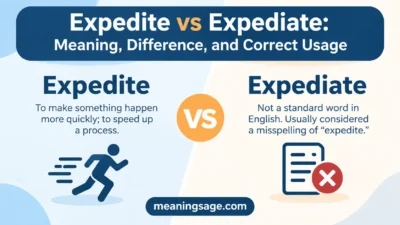

Ascend vs Ascent are closely related words, but they are used differently in English. The main difference is that ascend is a verb meaning “to go up” or “to rise,” while ascent is a noun meaning “the act or process of going upward.”
Although they come from the same Latin root and describe upward movement, they cannot be used interchangeably. Understanding the difference helps you choose the correct word in writing and everyday conversation.
Quick Answer
Ascend means to move upward, climb, or rise, and it is used as an action word (verb). Ascent refers to the upward movement itself, the journey upward, or the process of climbing, and it is used as a noun. For example, “The plane will ascend” describes the action, while “The plane’s ascent was smooth” describes the event.
What Does Ascend Mean?
Ascend is a verb that means to move from a lower position to a higher one. It can describe physical movement, such as climbing a mountain, or figurative changes, such as gaining power or reaching a higher level.
The word often suggests progress, elevation, or movement toward something higher.
Examples of Ascend
- The hikers began to ascend the steep mountain trail.
- The balloon slowly ascended into the sky.
- She worked hard to ascend to a leadership position.
- The elevator will ascend to the top floor.
In each example, ascend describes an action being performed.
What Does Ascent Mean?
Ascent is a noun that describes the act, process, or journey of moving upward. It refers to the event or experience of rising rather than the action itself.
It can describe physical climbing, social progress, or a rise in importance.
Examples of Ascent
- The climbers prepared for the difficult ascent up the mountain.
- The rocket’s ascent was visible from miles away.
- His rapid ascent in the company surprised everyone.
- The aircraft began its smooth ascent after takeoff.
In these sentences, ascent names the process of going upward.
Ascend vs Ascent: Key Difference
| Word | Part of Speech | Meaning | Example |
|---|---|---|---|
| Ascend | Verb | To move upward or rise | The bird began to ascend. |
| Ascent | Noun | The process of moving upward | The bird’s ascent was beautiful. |
| Ascend | Action | Describes what someone or something does | They ascend the stairs. |
| Ascent | Event | Describes the upward journey | Their ascent took hours. |
How to Use Ascend Correctly
Use ascend when you need an action word. It answers the question: “What is happening?”
Common structures include:
- ascend + object
- She ascended the stairs.
- ascend + to + place or position
- He ascended to the throne.
- ascend + into + area
- Smoke ascended into the air.
More Examples
- The sun began to ascend above the horizon.
- The athlete hopes to ascend to the highest level of competition.
- The temperature continued to ascend throughout the afternoon.
How to Use Ascent Correctly
Use ascent when you are naming the upward movement or journey.
Common structures include:
- the ascent of + noun
- The ascent of the mountain was challenging.
- a rapid/slow/difficult ascent
- The rocket made a rapid ascent.
- during the ascent
- Passengers felt pressure during the ascent.
More Examples
- The final ascent required careful planning.
- The company’s ascent was driven by innovation.
- The airplane’s ascent was delayed because of weather.
Common Mistake: Using Ascend as a Noun
Incorrect:
- The ascend of the mountain was exhausting.
Correct:
- The ascent of the mountain was exhausting.
Why?
“Ascend” describes an action, while “ascent” names the activity or journey.
Common Mistake: Using Ascent as a Verb
Incorrect:
- The plane will ascent into the clouds.
Correct:
- The plane will ascend into the clouds.
Why?
“Ascent” cannot show an action because it is a noun.
Ascend and Ascent in Figurative Meaning
Both words can describe more than physical movement.
Ascend (Figurative)
Used for gaining status, power, or success.
Example:
- The politician began to ascend in popularity.
Ascent (Figurative)
Used for describing a rise or journey toward success.
Example:
- Her ascent to fame happened quickly.
These uses are common in news, business writing, and biographies.
Synonyms of Ascend
Depending on the context, synonyms include:
- rise
- climb
- go up
- elevate
- increase
- move upward
Example:
- The smoke ascended.
- The smoke rose.
Synonyms of Ascent
Depending on the context, synonyms include:
- climb
- rise
- elevation
- upward movement
- journey upward
Example:
- The mountain ascent was difficult.
- The mountain climb was difficult.
Origin of Ascend and Ascent
Both words come from Latin roots connected with climbing or rising. They entered English through French and developed related meanings.
Because they share the same origin, their meanings remain closely connected today. The main difference is their grammatical role: ascend describes the action, while ascent describes the process.
When Should You Use Ascend vs Ascent?
Use ascend when:
- someone or something is moving upward
- you need a verb
- you are describing an action
Example:
- The spacecraft will ascend.
Use ascent when:
- you are naming the upward movement
- you need a noun
- you are describing a journey or process
Example:
- The spacecraft’s ascent was successful.
Frequently Asked Questions
Is ascend a verb or noun?
Ascend is a verb. It describes the action of moving upward, climbing, or rising.
Is ascent the same as climb?
Not exactly. Ascent can mean a climb, but it focuses on the upward movement or process rather than the physical act alone.
Can ascend and ascent be used interchangeably?
No. They have related meanings but different grammatical functions. Ascend is a verb, while ascent is a noun.
What is an example sentence with ascend?
“The eagle began to ascend above the mountains.” Here, ascend describes the eagle’s upward movement.
What is an example sentence with ascent?
“The climber’s ascent took several hours.” Here, ascent refers to the climbing journey.
Conclusion
Ascend vs ascent is mainly a difference between an action and a thing. Use ascend when something moves upward, and use ascent when you are talking about the upward journey, process, or event.
Remember this simple rule: you ascend, but you make an ascent. Understanding this distinction will help you use both words correctly in everyday English and formal writing.