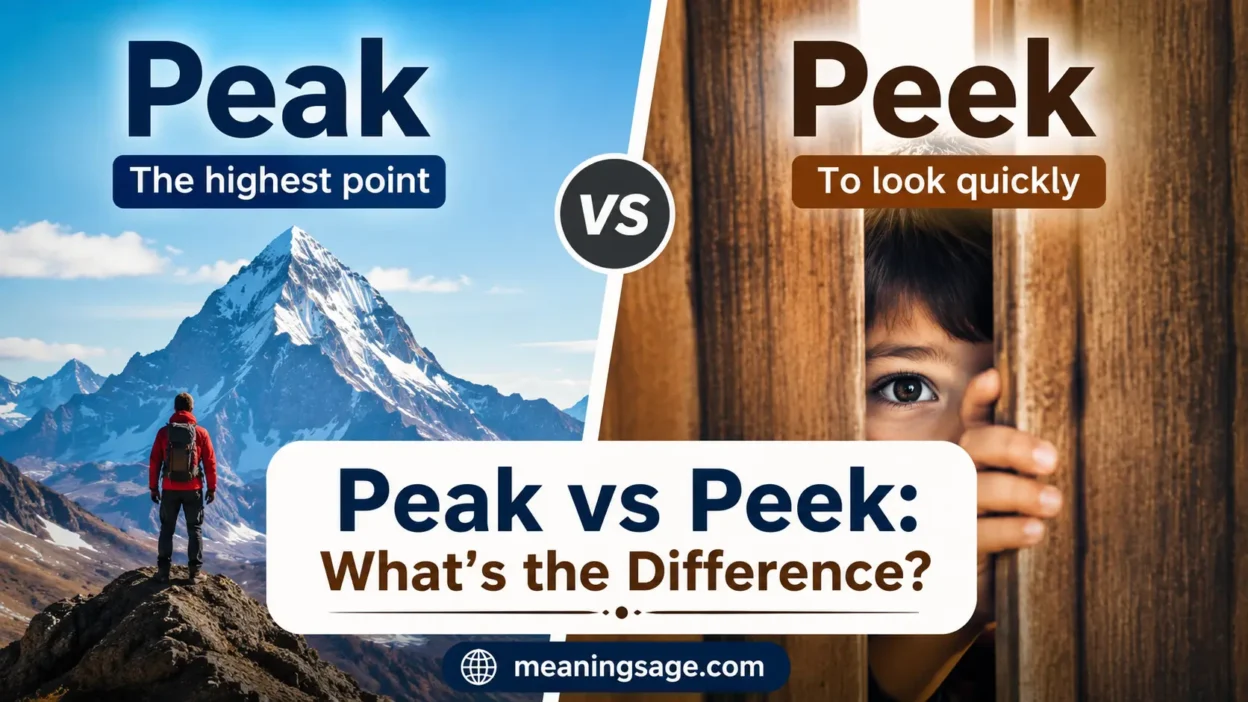
Peak vs Peek are commonly confused words because they sound the same, but they have very different meanings. Peak usually refers to the highest point or level, while peek means to take a quick or secret look. Understanding the difference makes it easier to choose the correct word in everyday writing and conversation.
The difference becomes easy to remember once you connect peak with height and peek with sight. You can reach the peak of a mountain, but you peek through a window.
Quick Answer
Use peak when you mean the highest point, greatest level, or busiest period. Use peek when you mean a quick or secret look.
- Peak: The athlete was at the peak of her career.
- Peek: I took a peek inside the box.
The two words are pronounced the same, but they’re not interchangeable.
Peak vs Peek at a Glance
| Word | Main Meaning | Common Use | Example |
| Peak | Highest point or level | Mountains, performance, demand, seasons | Sales reached their peak in December. |
| Peek | A quick or secret look | Looking, checking, glancing | She peeked through the door. |
The easiest rule: peak means highest point; peek means look.
What Does Peak Mean?
Peak commonly means the highest point, level, degree, or stage that something reaches. It can refer to a physical mountain top or a figurative high point in performance, popularity, or activity — “the hikers finally reached the peak,” “her confidence was at its peak,” “sales peaked just before the holidays.” In each case, peak carries the idea of reaching or nearing a maximum.
As a noun, peak refers to the top of a mountain or the highest level of something — Cambridge describes it as the highest, strongest, or best point or level. “The mountain peak was covered with snow.” “Demand reached a peak in July.”
As a verb, peak means to reach the highest point: “the company’s sales peaked last summer,” “temperatures usually peak in the afternoon.”
As an adjective, peak describes a period when something is at its highest or busiest level — think “peak season,” “peak hours,” and “peak demand.” Cambridge uses “peak” this way for periods when activity or use is especially high: “we traveled during peak season,” “avoid the highway during peak traffic hours.”
What Does Peek Mean?
Peek means to look at something briefly, quickly, or sometimes secretly, and it works as both a verb and a noun.
As a verb: “she peeked around the corner,” “don’t peek at your birthday present,” “he peeked through the curtains.” As a noun: “can I take a peek?” “she took a quick peek at the message.” The idea behind peek is always connected to seeing or looking, however briefly.
What Does “Take a Peek” Mean?
“Take a peek” means to look at something briefly — Cambridge defines the expression as looking at something for a short time. “Take a peek at the new design.” “She took a peek at the menu before entering the restaurant.” If you can replace the phrase with “take a quick look,” peek is probably the word you need.
Sneak Peek or Sneak Peak?
The correct expression is sneak peek, not sneak peak. A sneak peek is a secret, early, or brief look at something, often before it becomes officially available: “we got a sneak peek at the new movie,” “the company released a sneak peek of its upcoming product.” The mistake happens because peak and peek sound identical, but a preview involves looking, so peek is the correct spelling.
Peak vs Peek in Sentences
Compare how the meaning changes:
- Peak: The climbers reached the peak before sunset. / Peek: The children peeked inside the tent.
- Peak: Electricity use reaches its peak in the evening. / Peek: Take a peek at the final page.
- Peak: She performed at her peak during the tournament. / Peek: He peeked through the blinds.
Notice the pattern: peak relates to a maximum or highest point, while peek relates to looking.
How to Remember Peak vs Peek
A simple memory trick can prevent most mistakes. Think of the “A” in peak as pointing upward like a mountain — peak is connected with something reaching the top. For peek, remember that the double “e” can remind you of eyes; if the sentence involves looking or seeing, choose peek. So: mountain or maximum means peak, eyes or looking means peek.
Common Peak and Peek Mistakes
Incorrect: Here’s a sneak peak of our new collection. Correct: Here’s a sneak peek of our new collection.
Incorrect: The athlete was at the peek of his career. Correct: The athlete was at the peak of his career. (A career has a highest point.)
Incorrect: I took a peak inside the room. Correct: I took a peek inside the room. (You’re describing a look.)
What About Pique?
There’s a third word that causes additional confusion: pique. Pique, peak, and peek are pronounced alike, but their meanings differ — Merriam-Webster distinguishes peek as relating to looking, peak as relating to a maximum, and pique as a verb meaning to arouse or stimulate something such as curiosity.
“The headline piqued my curiosity.” “The mountain peak was visible from town.” “I peeked through the window.” The standard expression is therefore “pique your interest,” never “peak your interest” or “peek your interest.”
Peak vs Peek: Which One Should You Use?
Choose peak when your sentence involves a top, maximum, or busiest period. Choose peek when someone is looking or getting a brief view of something. Ask yourself: am I talking about a high point or a look? High point means peak; look means peek.
Frequently Asked Questions
Are peak and peek the same word?
No. Peak and peek sound the same but have different spellings and meanings. Peak relates mainly to a highest point or level, while peek relates to looking briefly.
Is it “take a peak” or “take a peek”?
“Take a peek” is correct when you mean “take a quick look.” Cambridge recognizes “take a peek” as an expression for looking at something briefly.
Is it sneak peak or sneak peek?
The correct phrase is “sneak peek.” It means a secret, brief, or advance look at something.
Is it peak performance or peek performance?
“Peak performance” is correct. Here, peak means the highest or best level of performance.
Is it peak season or peek season?
“Peak season” is correct. It describes the period when demand, activity, or business is at a particularly high level.
Is it “peek through the window” or “peak through the window”?
Use “peek through the window” because the sentence describes looking. “Peak” would be incorrect in this context.
Is it peak my interest or pique my interest?
The correct expression is “pique my interest.” In this phrase, pique means to arouse or stimulate interest or curiosity.
Conclusion
Peak and peek are easy to confuse because they sound the same, but their meanings are clearly different. Use peak for the highest point, greatest level, or busiest period. Use peek for a quick, brief, or secret look.
Remember the basic rule: peak is about height, peek is about sight. That distinction will help you choose the correct spelling in phrases such as peak performance, peak season, take a peek, and sneak peek.