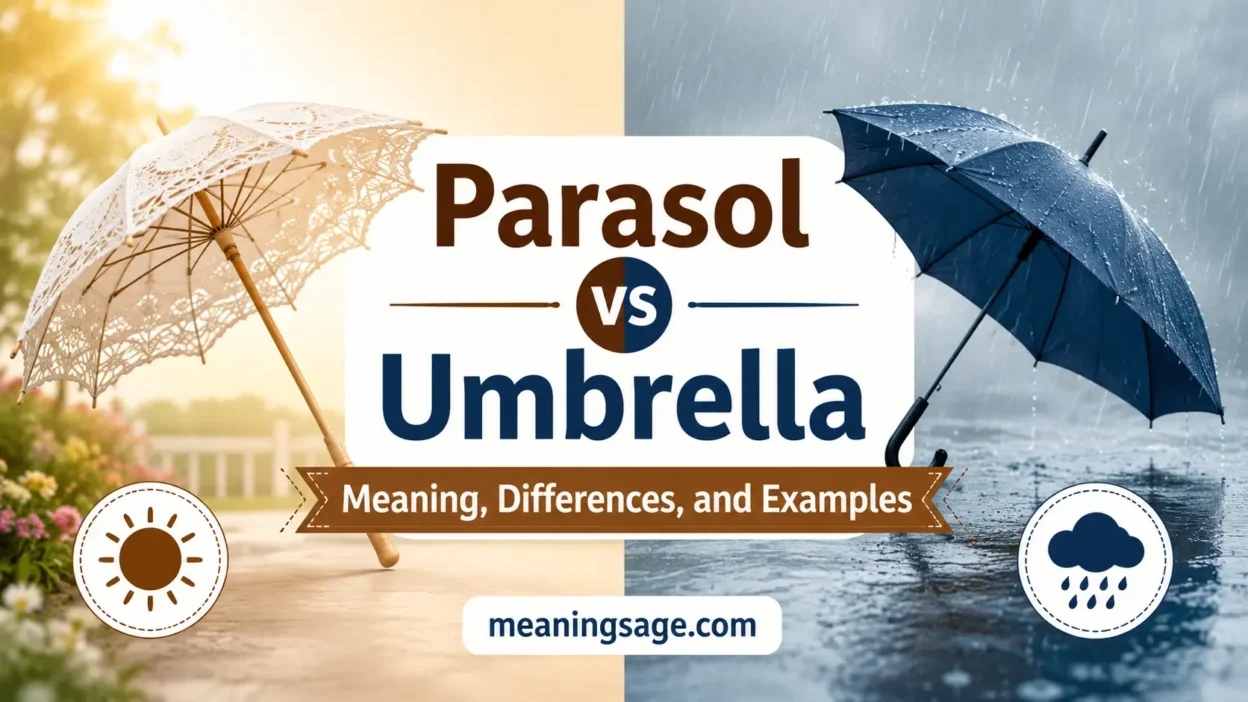
Parasol vs Umbrella A parasol and an umbrella look very similar, but they’re traditionally designed for different purposes. A parasol provides shade from the sun, while an umbrella is most commonly used to protect against rain.
The distinction isn’t absolute, though. Some modern umbrellas provide both rain and UV protection, and larger outdoor umbrellas can also serve as sunshades. Still, when choosing the correct word, the weather and intended purpose usually tell you which one fits best. Merriam-Webster defines a parasol as a lightweight umbrella used as a sunshade, while Cambridge describes an umbrella primarily as a device used for protection against rain.
Quick Answer
A parasol is primarily designed to provide shade and protection from the sun. An umbrella is primarily designed to protect a person from rain, although some umbrellas also block sunlight. Parasols are often lighter and may use decorative fabrics, while rain umbrellas typically use water-resistant materials.
Parasol vs Umbrella: The Main Difference
The easiest way to remember it: parasol means sun protection, umbrella means rain protection.
A parasol is essentially a type of sunshade — Merriam-Webster specifically defines it as a lightweight umbrella used for shade, while the broader word “umbrella” can describe a folding canopy used for protection from weather generally. For example: “She carried a parasol to keep the afternoon sun off her face.” “He opened his umbrella when the rain began.” “We sat beneath a large beach umbrella for shade.”
That last example shows why the distinction can overlap. English speakers commonly call large beach and patio sunshades “umbrellas,” even though their main purpose is protection from sunlight — Merriam-Webster defines a “beach umbrella” as a large umbrella used to provide shade at places such as beaches and patios.
What Is a Parasol?
A parasol is a lightweight canopy or umbrella-like object designed mainly to shield someone from sunlight. It’s a countable noun (one parasol, two parasols), and while parasols are typically handheld, the word is also used for larger outdoor sunshades in some contexts.
- She walked through the garden carrying a white parasol.
- Colorful parasols provided shade beside the pool.
- Her vintage outfit included gloves and a lace parasol.
A parasol doesn’t automatically imply protection from rain. Unless a specific product is made with waterproof material, you shouldn’t assume it will function like a rain umbrella.
What Is an Umbrella?
An umbrella is a folding or collapsible canopy supported by ribs and attached to a central shaft. In ordinary American English, the word most often refers to the portable object people carry for protection from rain — Cambridge gives rain protection as its primary everyday sense while also recognizing larger umbrellas used for sun protection.
- Take an umbrella because it may rain.
- I left my umbrella in the car.
- We rented an umbrella at the beach.
Unlike “parasol,” though, “umbrella” also carries an important figurative meaning — it can describe something that includes or covers several smaller groups, ideas, or activities. Merriam-Webster records this broader sense as something covering or embracing a range of elements: “several programs operate under the same organizational umbrella,” or “‘digital marketing’ is an umbrella term covering several different activities.” You wouldn’t normally use “parasol” this figurative way.
Parasol vs Umbrella Comparison
| Feature | Parasol | Umbrella |
| Main purpose | Protection from sun | Protection from rain |
| Typical use | Shade | Wet weather |
| Structure | Umbrella-like canopy | Folding canopy with ribs |
| Material | Often lightweight | Usually suited to wet weather |
| Decorative use | Common | Possible |
| Beach or patio use | Yes | Yes |
| Figurative meaning | Rare | Common |
| Everyday US usage | Less common | Very common |
The physical designs can overlap considerably, so the purpose of the object is often more useful than its exact shape when choosing which word to use.
Can You Use an Umbrella for the Sun?
Yes. An umbrella can be used for sun protection, especially if it’s designed to block UV rays. English also commonly uses expressions like “beach umbrella,” “patio umbrella,” and “sun umbrella” for larger structures intended mainly to create shade — Cambridge likewise notes that an umbrella can refer to a similar, often larger device used for sun protection. So “let’s sit under the beach umbrella” is completely natural, even with no rain in sight.
Can You Use a Parasol in the Rain?
Sometimes physically, but “parasol” doesn’t normally mean a rain-protection device. Traditional parasols are designed primarily for shade — some may use materials that tolerate light moisture, while others are decorative or unsuitable for heavy rain. If rain protection is the main purpose, “umbrella” is the clearer word to use.
Why Do Parasols and Umbrellas Look So Similar?
They perform a similar basic physical job: placing a canopy between a person and the weather. Their names, though, reflect their historical connection with shade specifically. “Parasol” entered English through French and Italian — Merriam-Webster traces it to Italian parasole, built from elements associated with shielding and the sun. The history of “umbrella” also connects with shade, traced through Italian and Latin forms associated with shade or shadow.
Over time, “umbrella” became strongly associated with protection from rain in everyday English, while “parasol” retained its closer connection with sunlight specifically.
Is “Parasol” an Old-Fashioned Word?
Not exactly. A handheld decorative parasol can have a historical or vintage feel, since such accessories are strongly associated with older fashions — Cambridge specifically notes this historical association with sun protection. But “parasol” is still a current English word, describing modern sunshades used at pools, beaches, resorts, and outdoor seating areas. In American English, though, “umbrella” is generally the more familiar everyday word for many umbrella-shaped outdoor shades.
Parasol vs Sun Umbrella
A “sun umbrella” and a “parasol” can refer to essentially the same type of sun-protection device — the difference is often one of style and context. “Parasol” may suggest a lightweight sunshade or a decorative handheld accessory, while “sun umbrella” sounds more descriptive and practical, immediately telling the reader that the umbrella is intended for sunlight rather than rain.
Parasol vs Beach Umbrella
A beach umbrella is usually much larger than a traditional handheld parasol. Both create shade, but their typical uses differ — a parasol may be carried or positioned over a seating area, while a beach umbrella is normally planted or secured in the ground to shade people sitting on the beach. In casual US English, “beach umbrella” is generally the more natural term for that large shade structure.
Common Mistakes
Using “parasol” for an ordinary rain umbrella. “I brought my parasol because it’s raining” sounds off — “I brought my umbrella because it’s raining” is the natural choice when rain protection is the intended meaning.
Assuming every umbrella is only for rain. Umbrellas can also provide shade — “we sat under an umbrella by the pool” is completely natural, since “umbrella” has a broader range of practical uses than “parasol.”
Assuming parasol and umbrella are always interchangeable. They overlap, but they emphasize different functions. A parasol specifically points toward sun protection, while umbrella is the broader and more common term, particularly for rain protection.
Parasol vs Umbrella Examples
- Parasol: The bride carried a lace parasol during the outdoor ceremony.
- Umbrella: Bring an umbrella because thunderstorms are expected this afternoon.
- Parasol: Guests relaxed beneath parasols beside the hotel pool.
- Umbrella: His umbrella turned inside out in the strong wind.
- Umbrella used for sun: We set up a large beach umbrella before sitting on the sand.
These examples show that an umbrella can provide either rain or sun protection, while “parasol” strongly emphasizes shade from sunlight specifically.
Frequently Asked Questions
Is a parasol the same as an umbrella?
Not exactly. A parasol is specifically associated with protection from sunlight, while an umbrella is most commonly associated with protection from rain. Their designs can be very similar.
What is the difference between a parasol and an umbrella?
The main difference is their intended purpose. A parasol primarily provides shade from the sun, whereas an umbrella primarily protects against rain
Is a parasol waterproof?
Not necessarily. Because parasols are designed mainly for sun protection, you shouldn’t assume a particular parasol is waterproof unless the manufacturer says so.
Can an umbrella be used as a parasol?
Yes. An umbrella can provide shade from sunlight, especially if it offers UV protection. Larger beach and patio umbrellas are routinely used primarily as sunshades.
Do Americans use the word “parasol”?
Yes, but it’s less common in ordinary conversation than “umbrella.” Americans may encounter “parasol” in fashion, historical descriptions, outdoor décor, resorts, and products specifically designed as sunshades.
What is another word for parasol? “
“Sunshade” is the closest general alternative. Merriam-Webster lists a parasol as one type of sunshade.
Which word should I use: parasol or umbrella?
Use “parasol” when you specifically mean an object designed to provide shade from the sun. Use “umbrella” for ordinary rain protection or when referring more generally to an umbrella-shaped shade.
Conclusion
The difference between parasol and umbrella mainly comes down to purpose. A parasol protects against sunlight, while an umbrella usually protects against rain.
The terms can overlap because modern umbrellas may provide sun and UV protection, and large beach or patio umbrellas are commonly used for shade. When the distinction matters, remember the simple rule: parasol for sun, umbrella for rain.