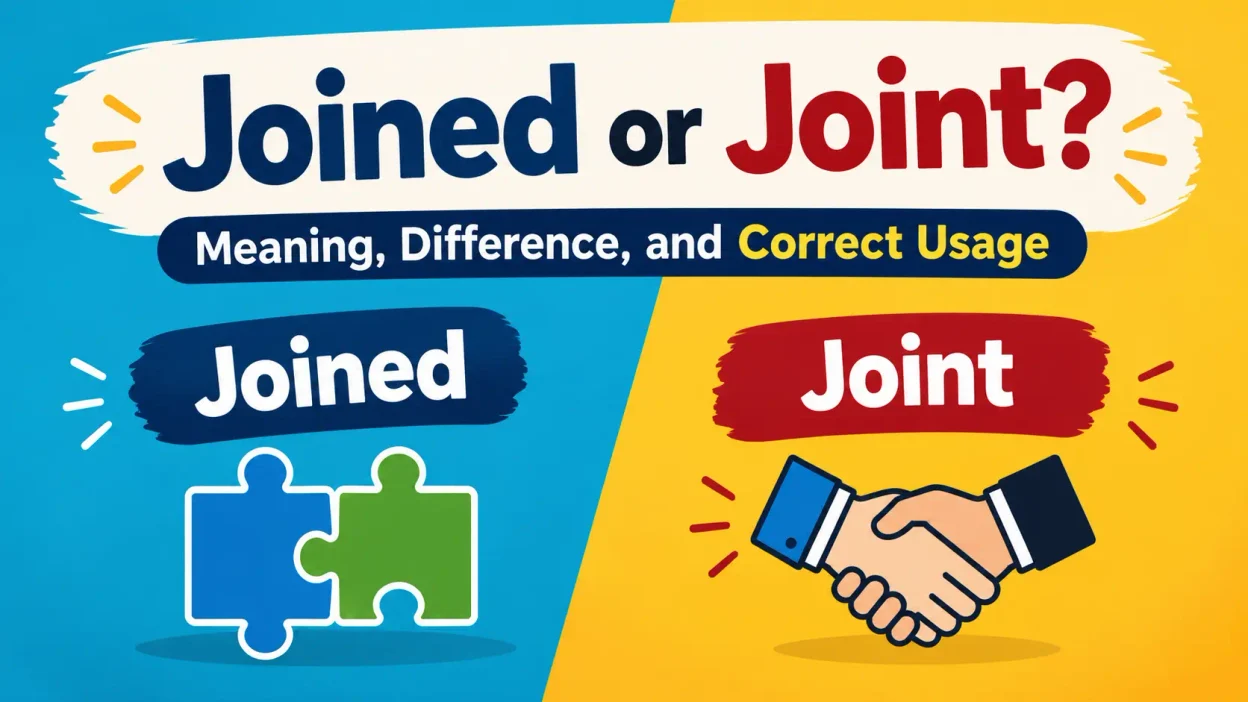
Joined or Joint are two English words that look very similar, but they are not interchangeable. The main difference is grammatical as well as semantic: joined is usually a form of the verb join, while joint commonly works as an adjective meaning shared, combined, or involving two or more people or groups.
For example, you can say “I joined the team,” but you would say “We made a joint decision.”
Knowing this difference is especially useful in everyday writing, workplace communication, emails, and formal documents.
Quick Answer: Joined vs. Joint
Use joined when you mean became a member, came together, connected, or went with someone.
I joined the company last year.
Use joint when you mean shared, combined, or done together by two or more people or groups.
The companies released a joint statement.
In short:
Joined = became part of, connected, or went with
Joint = shared, combined, or done together
What Does “Joined” Mean?
Joined is the past tense and past participle of the verb join.
The word can describe several related actions. Someone can join a group, organization, activity, conversation, or event. Two things can also be joined when they are connected or brought together.
Examples of “joined”
- I joined the company in January.
- She joined the meeting at 10 a.m.
- David joined his friends for dinner.
- They joined the team last season.
- The two roads are joined by a bridge.
In each example, joined describes an action or a resulting connection.
Common phrases with “joined”
You will often see joined in expressions such as:
- joined the team
- joined the company
- joined the meeting
- joined the group
- joined the conversation
- joined the discussion
- joined us for dinner
- joined together
For example:
Maria joined the discussion after reading the report.
This means Maria became part of the discussion.
What Does “Joint” Mean?
Joint is commonly used as an adjective to describe something that is shared, combined, or done by two or more people, organizations, or groups.
For example:
The two companies announced a joint venture.
The venture involves both companies.
Other common examples include:
- joint decision
- joint effort
- joint project
- joint statement
- joint meeting
- joint account
- joint responsibility
- joint agreement
Examples of “joint”
We made a joint decision.
This means the decision was made together.
The organizations issued a joint statement.
This means both organizations participated in issuing the statement.
They opened a joint account.
This means the account is shared by two or more people.
The Main Difference Between Joined and Joint
The easiest way to understand the difference is to look at their grammatical roles.
| Word | Common role | Basic meaning | Example |
|---|---|---|---|
| Joined | Verb form | Became part of, connected, or went with | I joined the team. |
| Joint | Adjective | Shared or done together | We made a joint decision. |
So, joined usually tells you what someone or something did, while joint usually tells you that something is shared or collective.
Compare these sentences:
I joined the company.
This means I became a member or employee of the company.
I worked on a joint project with the company.
This means the project was carried out together.
The two words may appear in similar situations, but they perform different jobs in the sentence.
Joined or Joint: Which One Is Correct?
The correct word depends on the meaning you want to express.
Use “joined” for membership or participation
She joined the marketing team.
He joined the meeting late.
We joined our friends for lunch.
In these sentences, someone becomes involved in or participates in something.
Use “joint” for shared activities or responsibilities
They organized a joint meeting.
The two departments prepared a joint report.
The partners made a joint decision.
Here, two or more people or groups are involved together.
“I Joined the Meeting” or “I Joint the Meeting”?
The correct sentence is:
I joined the meeting.
“I joint the meeting” is incorrect if you mean that you attended or entered the meeting.
The verb is:
join → joined
Examples:
- I join the meeting every Monday.
- I joined the meeting yesterday.
- She has joined the meeting already.
By contrast, joint does not serve as the past tense of join.
“Joint Meeting” or “Joined Meeting”?
If you mean a meeting involving two or more groups, the natural expression is:
joint meeting
For example:
The finance and marketing departments held a joint meeting.
Here, joint means the meeting was shared by the two departments.
If you mean that someone entered or participated in a meeting, use joined:
James joined the meeting at noon.
These sentences express two different ideas:
- James joined the meeting. → James participated in the meeting.
- The departments held a joint meeting. → Both departments participated in the same meeting.
Joined vs. Joint in the Workplace
The distinction is particularly important in professional English.
Joined
Use joined when talking about someone becoming part of a company, team, meeting, or project.
Sarah joined the company in 2024.
Michael joined the project last week.
Joint
Use joint when describing work or responsibilities shared by different people or organizations.
Sarah and Michael worked on a joint project.
The companies issued a joint report.
This distinction can make professional writing much clearer.
Common Mistakes
Mistake 1: “I joint the team.”
❌ Incorrect:
I joint the team last year.
✅ Correct:
I joined the team last year.
Why?
The past tense of join is joined.
Mistake 2: “They made a joined decision.”
❌ Usually incorrect:
They made a joined decision.
✅ Natural:
They made a joint decision.
Why?
A decision made by two or more people together is a joint decision.
Mistake 3: “We joint the meeting.”
❌ Incorrect:
We joint the meeting at 9 a.m.
✅ Correct:
We joined the meeting at 9 a.m.
Again, joined is the correct past-tense verb.
Joined and Joint in Simple Sentences
Here are some quick examples to make the difference easier to remember:
Joined
I joined the gym last month.
She joined the conversation.
They joined us for dinner.
He joined the organization in 2025.
Joint
We opened a joint account.
They made a joint decision.
The companies started a joint project.
The teams held a joint meeting.
A Simple Trick to Remember the Difference
Think of joined as an action and joint as a description of something shared.
Joined = action
Someone joined something.
She joined the team.
Joint = shared
Something is joint.
It was a joint project.
A useful memory formula is:
Join → Joined
Joint → Shared/Together
If you are talking about becoming part of something, you probably need joined.
If you are describing something shared by two or more people or groups, you probably need joint.
Frequently Asked Questions
Is “joined” the past tense of “join”?
Yes. Joined is both the simple past tense and past participle of join.
Present: I join the team.
Past: I joined the team.
Perfect: I have joined the team.
Is “joint” the same as “joined”?
No. They have different meanings and grammatical uses. Joined is a form of the verb join, while joint commonly means shared or combined.
Is “I joint the team” correct?
No. The correct sentence is:
I joined the team.
Is “joint project” correct?
Yes. A joint project is a project carried out together by two or more people, teams, companies, or organizations.
Is “joined project” correct?
It can occur in specific contexts, but it does not normally mean “a project shared by two groups.” For that meaning, joint project is the natural expression.
Which is correct: “joint account” or “joined account”?
Joint account is correct when an account is shared by two or more people.
They opened a joint account.
Which is correct: “joined the company” or “joint the company”?
The correct expression is:
joined the company
For example:
She joined the company in March.
Final Difference
The distinction between joined and joint is simple once you focus on their meanings.
Joined is generally used for an action involving joining, becoming part of something, participating, or connecting.
Joint is generally used to describe something that is shared, combined, or done together.
Compare:
I joined the team.
and
We worked on a joint project.
The first tells us that someone became part of a team. The second describes a project shared by multiple people or groups.
So remember:
Joined = became part of / connected / participated
Joint = shared / combined / together
Using this simple distinction will help you choose the right word in everyday conversation, workplace writing, emails, and formal English.