
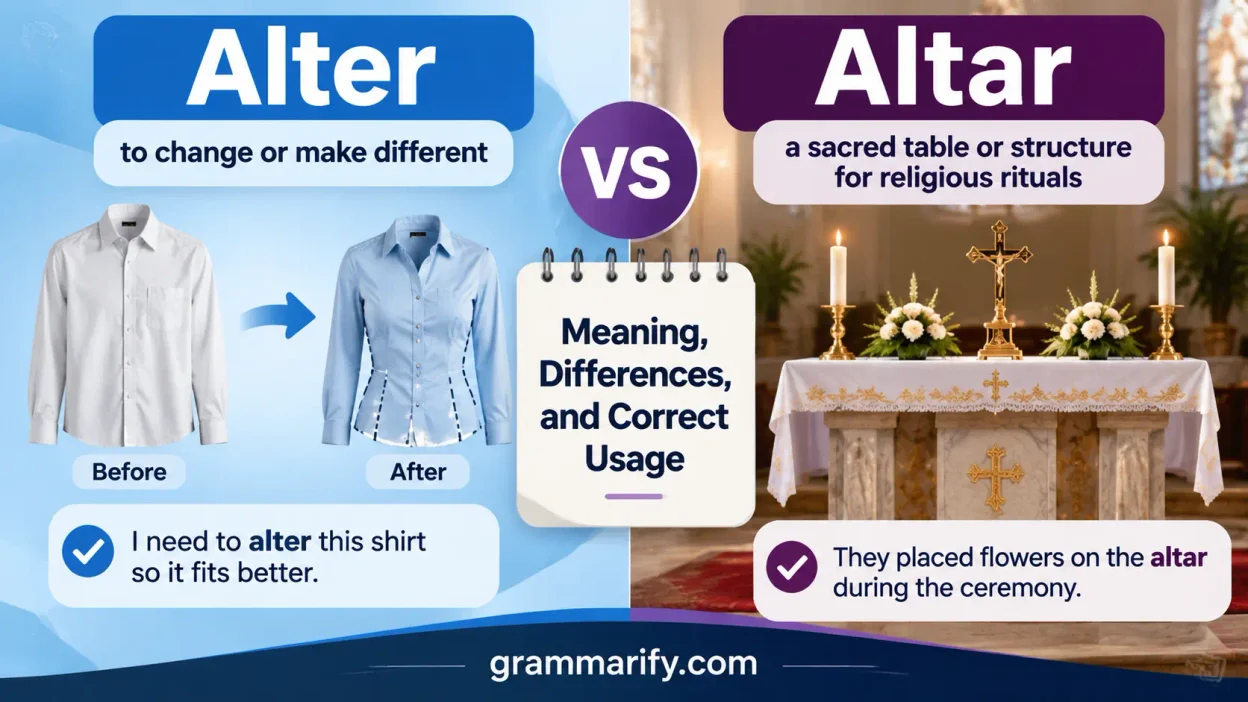
Alter vs Altar are two English words that sound exactly the same but have completely different meanings. They are examples of homophones, which are words with the same pronunciation but different spellings and definitions.
Because these words sound identical when spoken, many writers confuse them in emails, essays, social media posts, and everyday writing. The mistake usually happens because people remember the sound of the word but not its meaning or spelling.
The difference is simple: alter is usually a verb that means to change or modify something, while altar is a noun that refers to a sacred table, structure, or place used in religious ceremonies. Understanding the difference helps you avoid one of the most common spelling mistakes in English.
Quick Answer
Alter means “to change, adjust, or modify something.” It is commonly used for changing clothing, plans, designs, ideas, or situations.
Altar means a sacred table or raised structure used for religious ceremonies, prayers, offerings, or worship. It is also commonly associated with weddings, where couples traditionally stand before an altar.
A simple way to remember the difference is: you alter something to change it, but you kneel at an altar.
What Does Alter Mean?
Alter is a verb that means to make a change to something without completely replacing it. The change can be small or significant, depending on the situation.
When you alter something, you modify its appearance, condition, structure, purpose, or behavior.
For example:
- A tailor can alter a jacket to make it fit better.
- A company may alter its business plan after receiving new information.
- A person may alter their habits to improve their health.
- A designer may alter a building plan before construction begins.
The word focuses on the process of making changes.
The pronunciation of alter is:
AWL-ter
It has two syllables and is pronounced the same way as altar.
What Does Altar Mean?
Altar is a noun that refers to a special table, platform, or structure used for religious or spiritual purposes.
In many religions, an altar is a place where people perform ceremonies, offer prayers, present offerings, or conduct important rituals.
Examples include:
- A church altar where religious services take place.
- A temple altar used for worship or offerings.
- A family altar used for personal prayer or remembrance.
The word is strongly connected with religion and tradition, although it can also appear in cultural or historical discussions.
The pronunciation of altar is:
AWL-ter
Even though it sounds exactly like alter, the meaning is completely different.
Alter vs Altar: Main Difference
The biggest difference between alter and altar is their word type and meaning.
| Word | Part of Speech | Meaning | Example |
|---|---|---|---|
| Alter | Verb | To change or modify something | She altered the dress to fit better. |
| Altar | Noun | A sacred place or structure for worship | The couple stood at the altar. |
A useful memory trick:
Alter = Adjust
Both words begin with “alt,” but alter contains an “e,” which can remind you of “edit” or “enhance.” You alter something when you edit or change it.
Altar = A religious place
The spelling with “a” is connected to a sacred altar used in worship.
How to Use Alter Correctly
Because alter is a verb, it usually requires an object. Something is being changed.
Common sentence patterns include:
Subject + alter + object
Examples:
- The company altered its marketing strategy.
- She altered her dress before the event.
- The storm altered our travel plans.
- The artist altered the painting to improve the composition.
In these sentences, the subject performs an action that changes something else.
Common Uses of Alter
Alter Clothing
One of the most common uses of alter is related to clothing.
A tailor alters clothes by adjusting their size, shape, or design.
Examples:
- I need to alter these pants because they are too long.
- The wedding dress was altered to fit perfectly.
- The tailor altered my suit jacket.
This use does not mean creating new clothing. It means making adjustments.
Alter Plans or Decisions
People often use alter when plans or decisions change.
Examples:
- The weather altered our vacation plans.
- The manager altered the schedule.
- New information altered her opinion.
Alter Appearance or Design
Designers, artists, and builders often alter objects or ideas.
Examples:
- The architect altered the original design.
- The artist altered the colors in the painting.
- The company altered the product packaging.
How to Use Altar Correctly
Because altar is a noun, it refers to a thing or place. It does not describe an action.
Common sentence patterns include:
Subject + verb + altar
Examples:
- The priest stood near the altar.
- The couple walked toward the altar.
- Flowers decorated the altar.
You do not “altar” something. You stand near, approach, decorate, or use an altar.
Common Uses of Altar
Religious Ceremonies
The most common meaning of altar relates to religious worship.
Examples:
- The candles were placed on the altar.
- The congregation gathered around the altar.
- The ceremony took place beside the altar.
Weddings
Many people recognize the word altar because of wedding traditions.
Examples:
- They exchanged vows at the altar.
- The bride walked toward the altar.
- The couple met at the altar during the ceremony.
However, not every wedding uses an altar. The term mainly applies to traditions where a ceremonial structure is involved.
Personal or Memorial Altars
Some people create personal altars for reflection, remembrance, or spiritual practice.
Examples:
- She created a small altar with family photographs.
- The memorial altar displayed flowers and candles.
Why Do People Confuse Alter and Altar?
The main reason these words are confusing is pronunciation.
English contains many homophones, including:
- two / too / to
- there / their / they’re
- hear / here
- right / write
- alter / altar
When people hear the words spoken, there is no sound difference between alter and altar. The spelling depends entirely on the meaning.
Another reason is that both words can appear in serious or formal writing, especially in religious, academic, or professional contexts.
Alter vs Altar Examples
Understanding examples is one of the easiest ways to remember the difference.
Correct Use of Alter
- The teacher altered the lesson plan.
- The designer altered the logo.
- The doctor advised him to alter his lifestyle.
- The tailor altered my coat.
- The company altered its policies.
In each example, something changes.
Correct Use of Altar
- The flowers were placed on the altar.
- The couple exchanged rings at the altar.
- The church altar was decorated for the ceremony.
- The family gathered near the altar.
- The priest prepared the altar.
In each example, the word refers to a sacred structure or place.
Common Mistakes With Alter and Altar
Mistake 1: Using Altar When You Mean Change
Incorrect:
The company decided to altar its strategy.
Correct:
The company decided to alter its strategy.
Explanation:
The company is changing something, so the correct word is alter.
Mistake 2: Using Alter for a Religious Structure
Incorrect:
The bride stood before the alter.
Correct:
The bride stood before the altar.
Explanation:
The sentence refers to a wedding structure, so the correct word is altar.
Mistake 3: Thinking They Are Different Pronunciations
Some learners believe alter and altar should sound different.
They do not. In standard American English, both words are pronounced the same way.
The difference exists only in spelling and meaning.
Alter vs Altar: Grammar Difference
The grammatical difference is important.
Alter
- Part of speech: Verb
- Meaning: To change or modify
Examples:
- They altered the agreement.
- She altered her hairstyle.
Altar
- Part of speech: Noun
- Meaning: A sacred structure or ceremonial place
Examples:
- The altar was decorated with flowers.
- They stood beside the altar.
A quick grammar test:
If the word describes an action, use alter.
If the word names a thing or place, use altar.
Synonyms for Alter
Depending on the context, synonyms for alter include:
- change
- modify
- adjust
- revise
- transform
- adapt
- revise
- update
Examples:
“Alter the plan” can also mean:
- Change the plan.
- Modify the plan.
- Revise the plan.
However, each synonym may have a slightly different meaning.
Synonyms for Altar
Synonyms for altar depend on context.
Possible related words include:
- shrine
- sanctuary table
- sacred table
- ceremonial platform
These words are not always exact replacements because religious traditions use different terms.
Related Homophones in English
Alter and altar belong to a large group of English homophones.
Other examples include:
Accept / Except
- Accept = receive or agree
- Except = excluding
Affect / Effect
- Affect = influence
- Effect = result
Stationary / Stationery
- Stationary = not moving
- Stationery = writing materials
Learning homophones improves spelling accuracy because it teaches you to focus on meaning, not only sound.
Memory Trick to Remember Alter vs Altar
Try these simple reminders:
Alter = Alter a situation
Both contain “er,” which can remind you of editing or changing something.
Example:
“I altered my plans.”
Altar = A religious place
The “a” can remind you that an altar is an object or place.
Example:
“They prayed at the altar.”
Another trick:
You alter something.
You stand near an altar.
Frequently Asked Questions
Is alter and altar the same word?
No. Alter and altar are different words with different meanings. They are homophones, meaning they sound the same but have different spellings and definitions.
Is alter a noun or verb?
Alter is a verb. It means to change, adjust, or modify something.
Example:
“She altered the design.”
Is altar only used in religion?
Mostly, yes. Altar usually refers to a sacred structure used in religious ceremonies. It can also refer to personal or cultural ceremonial spaces.
How do you remember alter vs altar?
Remember that you alter something when you change it, while an altar is a place used for worship or ceremonies.
Are alter and altar pronounced the same?
Yes. In American English, both words are usually pronounced the same way: AWL-ter.
Conclusion
The difference between alter and altar is easy once you connect each word with its meaning.
Alter is a verb that means to change, adjust, or modify something. You alter plans, clothing, designs, opinions, and situations.
Altar is a noun that refers to a sacred table, structure, or ceremonial place. People visit, decorate, or stand near an altar during religious or traditional events.
Although these words sound identical, their meanings are completely different. Remembering the difference between action and object will help you choose the correct spelling every time.


