
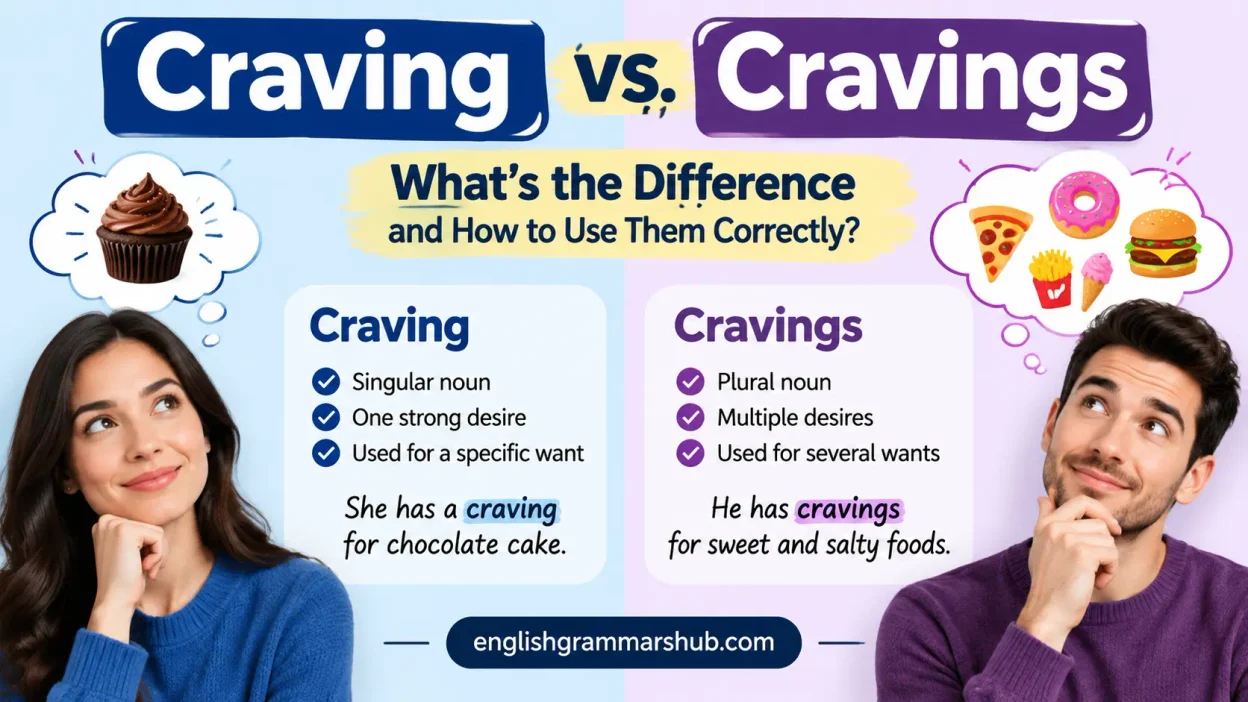
The words Craving vs. Cravings are closely related, but they are not used in exactly the same way. The difference is simple: craving is the singular form, while cravings is the plural form.
A craving refers to one strong desire for something, such as a specific food, activity, or experience. Cravings refers to multiple strong desires or repeated urges for different things.
For example:
- “I have a craving for chocolate.”
- “I often get cravings for sweets and salty snacks.”
Both words are correct. The choice depends on whether you are talking about one desire or more than one desire.
Quick Answer
Craving means a strong desire or urge for one specific thing. Use it when you are talking about a single feeling or desire.
Cravings means multiple strong desires or repeated urges. Use it when you are referring to more than one craving or a general pattern of wanting something.
What Does Craving Mean?
Craving is a noun that describes a powerful desire for something.
The thing someone wants can be physical, emotional, or psychological.
Common examples include:
- a craving for chocolate
- a craving for coffee
- a craving for attention
- a craving for adventure
- a craving for comfort
When someone says they have a craving, they usually mean the desire feels stronger than a normal preference.
For example:
“I don’t just want ice cream; I have a craving for it.”
This suggests a strong urge rather than a simple choice.
What Does Cravings Mean?
Cravings is simply the plural form of craving.
It refers to two or more strong desires.
Examples:
- “Pregnancy cravings can vary from person to person.”
- “She has cravings for both sweet and salty foods.”
- “His cravings for travel grew after his first international trip.”
The word can also describe repeated urges over time.
For example:
“I have cravings for fast food when I feel stressed.”
Here, the speaker is not talking about one single moment. They are describing a repeated pattern.
Craving vs. Cravings: Main Difference
The main difference is number.
| Word | Form | Meaning | Example |
|---|---|---|---|
| Craving | Singular | One strong desire | “I have a craving for pizza.” |
| Cravings | Plural | Multiple desires or repeated urges | “I get cravings for different foods.” |
Think of it this way:
- One desire = craving
- More than one desire = cravings
When Should You Use Craving?
Use craving when you are talking about one specific desire.
Examples:
Correct:
- “I have a craving for chocolate.”
- “She suddenly had a craving for ice cream.”
- “My craving for coffee starts every morning.”
In each sentence, there is one main desire.
Even if the craving lasts for hours or days, it can still be singular.
Example:
“My craving for sugar has been strong this week.”
The speaker has one type of craving: sugar.
When Should You Use Cravings?
Use cravings when you are discussing multiple desires.
Examples:
- “I have cravings for chocolate, chips, and cookies.”
- “Pregnancy cravings are common.”
- “His cravings changed after he improved his diet.”
The plural form is also common when talking about cravings as a general experience.
For example:
“Cravings can be difficult to manage.”
This means cravings in general, not one specific craving.
Craving and Cravings in Everyday English
Both forms are common in daily conversation.
People often use them when talking about:
- food
- health
- emotions
- habits
- addictions
- personal goals
Examples:
Food
Singular:
“I have a craving for spicy noodles.”
Plural:
“I get cravings for different foods at night.”
Emotional Desires
Singular:
“She had a craving for peace and quiet.”
Plural:
“People sometimes experience cravings for comfort or connection.”
Lifestyle
Singular:
“He felt a craving for change.”
Plural:
“Her cravings for new experiences influenced her decisions.”
Is Craving Only Used for Food?
No. Although craving is often associated with food, it can describe any strong desire.
Food examples:
- craving pizza
- craving chocolate
- craving coffee
Non-food examples:
- craving success
- craving freedom
- craving attention
- craving adventure
- craving approval
For example:
“The artist had a craving for creative freedom.”
This does not mean the person wanted food. It means they strongly desired a new experience or feeling.
Common Expressions With Craving
English speakers often use these patterns:
Craving for + noun
Example:
“I have a craving for cake.”
Meaning: a strong desire for cake.
Other examples:
- craving for sleep
- craving for excitement
- craving for independence
Craving + noun
Example:
“She had a chocolate craving.”
This structure is especially common with food.
Examples:
- sugar craving
- caffeine craving
- salt craving
Have a craving
This is one of the most common expressions.
Examples:
- “I have a craving for pizza.”
- “She had a craving for something sweet.”
Common Mistakes With Craving and Cravings
Mistake 1: Using “cravings” for one specific desire
Incorrect:
“I have a cravings for coffee.”
Correct:
“I have a craving for coffee.”
Why?
Because “a” can only be used with a singular noun.
Mistake 2: Using “craving” when talking about many desires
Incorrect:
“My craving include chocolate and chips.”
Correct:
“My cravings include chocolate and chips.”
Why?
Because multiple desires require the plural form.
Mistake 3: Confusing craving with liking
A craving is stronger than a normal preference.
Compare:
“I like chocolate.”
This means chocolate is enjoyable.
“I have a craving for chocolate.”
This means there is a strong urge to eat chocolate.
Craving vs. Desire: Are They the Same?
The words are related but not identical.
A desire is a general wish or want.
A craving is usually a stronger, more urgent desire.
Examples:
Desire:
“I desire a better career.”
Craving:
“I have a craving for chocolate.”
A craving often feels more immediate or difficult to ignore.
Craving vs. Urge: What’s the Difference?
An urge and a craving can overlap, but they have slightly different meanings.
An urge is a strong impulse to do something.
A craving is usually a strong desire for something.
Examples:
- “I had an urge to call my friend.”
- “I had a craving for ice cream.”
You can have an urge to act and a craving to obtain something.
Grammar: Is Craving a Verb or Noun?
The word craving can have different grammatical roles depending on the sentence.
Craving as a noun
Meaning: a strong desire.
Example:
“I have a craving for coffee.”
Here, “craving” is a noun.
Craving as part of a verb form
“Craving” can also come from the verb crave.
Example:
“She is craving chocolate.”
Here, “craving” is part of the present continuous verb phrase.
Meaning:
She strongly wants chocolate right now.
Examples: Craving vs. Cravings
Singular Craving Examples
- “I have a craving for chocolate.”
- “My biggest craving is spicy food.”
- “She developed a craving for fresh fruit.”
- “He satisfied his craving with a small snack.”
Plural Cravings Examples
- “Pregnancy cravings can be unpredictable.”
- “My cravings change depending on my mood.”
- “She has cravings for sweet and salty foods.”
- “Late-night cravings are common.”
How to Choose the Correct Word
Ask yourself one question:
Am I talking about one desire or several desires?
Use:
Craving
When there is one specific desire.
Example:
“I have a craving for ice cream.”
Cravings
When there are multiple desires or a general category.
Example:
“I have cravings for desserts.”
Frequently Asked Questions
Is craving singular or plural?
Craving is singular. Cravings is plural.
Example:
- “I have a craving for pizza.”
- “I have cravings for different foods.”
Can craving be used as a verb?
Yes. “Craving” can be part of the verb phrase “is craving.”
Example:
“She is craving chocolate.”
It means she strongly wants chocolate.
Are cravings always about food?
No. Cravings can involve food, emotions, experiences, or other desires.
Examples include:
- craving attention
- craving freedom
- craving success
Which is correct: “I have a craving” or “I have cravings”?
Both can be correct.
Use “I have a craving” for one specific desire.
Use “I have cravings” for repeated or multiple desires.
Is “craving” stronger than “wanting”?
Usually, yes. A craving suggests a stronger and more urgent desire than a simple want.
Example:
“I want coffee” is a preference.
“I have a craving for coffee” suggests a stronger urge.
Conclusion
The difference between craving and cravings is mainly about singular and plural use.
Use craving when you mean one strong desire:
“I have a craving for chocolate.”
Use cravings when you mean multiple desires or repeated urges:
“I get cravings for different snacks.”
Both forms are correct. Choosing the right one depends on whether you are describing one specific feeling or a broader pattern of desires.


