
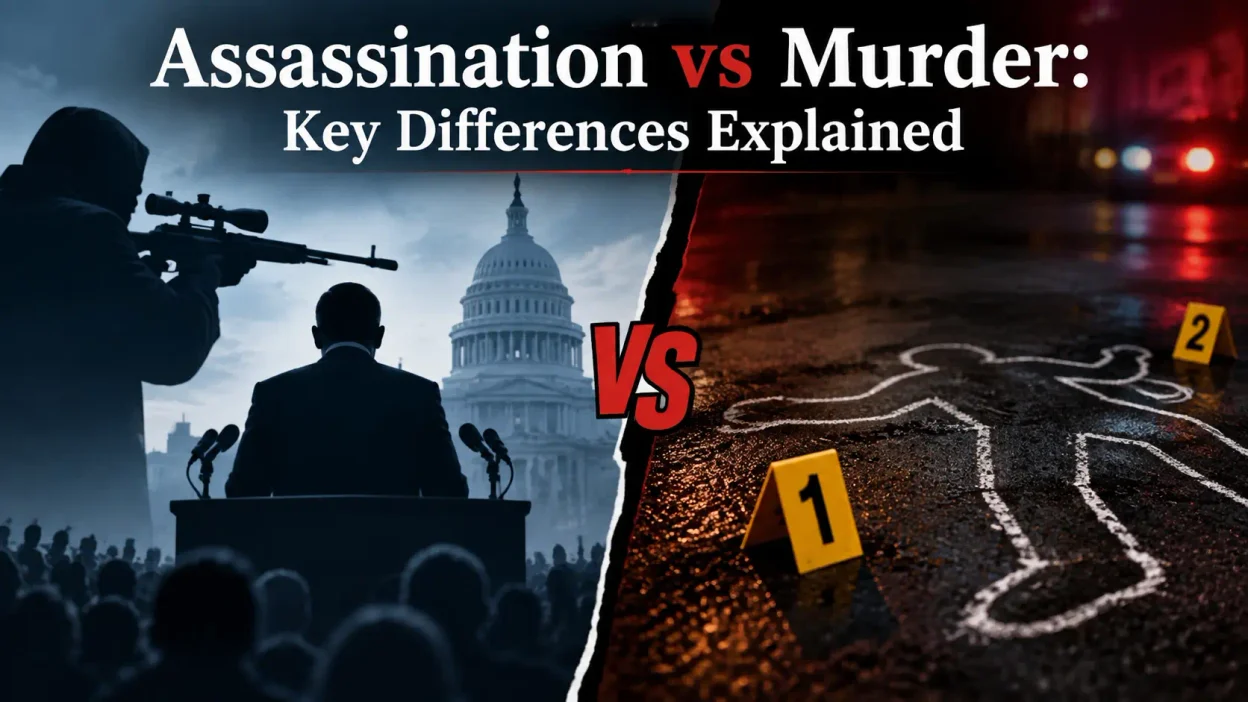
The words Assassination vs Murder both describe the intentional killing of another person, but they are not used in the same way. The main difference is that assassination usually refers to the planned killing of an important public figure or influential person, while murder is the broader term for any unlawful intentional killing of another person.
Understanding the difference helps readers use these words correctly in news reports, history discussions, legal conversations, and everyday English.
Quick Answer
Murder is the general term for intentionally and unlawfully killing another person. Assassination is a specific type of murder that usually involves a political leader, public figure, or influential person and is often connected to a larger motive such as politics, ideology, or power.
What Does Murder Mean?
Murder is the unlawful killing of one person by another person with intent or extreme disregard for human life. It is one of the most serious crimes recognized in legal systems, including in the United States.
The word can describe many different situations, including:
- A personal conflict that leads to a planned killing
- A criminal act for financial gain
- A killing connected to revenge or anger
- A deliberate act of violence
Examples:
- A person who intentionally kills a stranger during a robbery may be charged with murder.
- Someone who plans to kill another individual because of a personal dispute may commit murder.
Murder is a broad category. It does not require the victim to be famous, powerful, or publicly known.
What Does Assassination Mean?
Assassination is the deliberate killing of a prominent person, usually a political leader, government official, celebrity, activist, or other influential figure.
The term often carries the idea that the killing has a broader purpose beyond a personal conflict. Common motives may include:
- Political change
- Ideological beliefs
- Religious extremism
- Revenge against a public figure
- Attempts to influence events or society
Examples:
- The killing of a president for political reasons is commonly described as an assassination.
- The planned killing of an influential leader by an opposing group may be called an assassination.
Every assassination is a murder, but not every murder is an assassination.
Key Differences Between Assassination and Murder
| Feature | Assassination | Murder |
|---|---|---|
| Meaning | A targeted killing of an important person | Any intentional unlawful killing |
| Victim | Usually a public or influential figure | Any person |
| Motive | Often political, ideological, or strategic | Can involve many personal or criminal motives |
| Public impact | Often affects society or history | Usually affects individuals or communities |
| Category | A specific type of murder | A broader legal and general term |
Is Assassination a Legal Term?
In many legal systems, including the United States, assassination is not usually a separate criminal charge. A person accused of assassination may face charges such as murder, depending on the circumstances.
The word is mainly used in historical, political, and media contexts.
For example, news organizations may describe the killing of a national leader as an assassination, while courts may legally classify the act as murder.
How the Words Are Used in Everyday English
The choice between these words depends on the context.
Use murder when talking about intentional unlawful killing in general:
- “The police are investigating a murder.”
- “The suspect was charged with murder.”
Use assassination when the victim is a notable person and the killing has wider significance:
- “The assassination changed the course of the country’s history.”
- “The leader’s assassination shocked the world.”
Calling an ordinary killing an “assassination” may sound inaccurate because the word usually suggests a high-profile target.
Common Mistakes
Mistake 1: Using assassination for every planned killing
Incorrect:
“Someone was assassinated during a neighborhood dispute.”
Better:
“Someone was murdered during a neighborhood dispute.”
Why:
Assassination usually involves a prominent person or a broader public motive.
Mistake 2: Thinking assassination and murder are completely separate
Incorrect:
“An assassination is not murder.”
Better:
“An assassination is a specific form of murder.”
Why:
The difference is not whether someone died intentionally. The difference is the victim, context, and purpose behind the killing.
Similar Terms
Homicide
Homicide is a broad term meaning one person causing the death of another person. It does not always mean a crime because some forms, such as self-defense, may be legally justified.
Manslaughter
Manslaughter generally refers to an unlawful killing that does not involve the same level of planning or intent as murder.
Execution
Execution refers to a person being killed as a punishment carried out by legal authority, such as the death penalty in some jurisdictions.
Origin of the Words
The word murder comes from Old English and Germanic language roots connected to unlawful killing.
The word assassination comes from the medieval term “assassin,” which was associated with a group known for targeted killings. Over time, the word developed into its modern meaning of killing a notable person for political or other significant reasons.
Frequently Asked Questions
Is assassination the same as murder?
No. Assassination is a specific type of murder. It usually involves killing a prominent person for political, ideological, or strategic reasons.
Can a regular person be assassinated?
Usually, the word is not used for ordinary people. Assassination generally refers to public figures or people whose deaths have major social or political importance.
Is assassination a crime?
Yes, an assassination involves an unlawful killing. However, legal systems often charge it as murder rather than using assassination as a separate crime category.
What is the main difference between assassination and murder?
The main difference is the target and context. Murder applies to any intentional unlawful killing, while assassination usually involves an important person and a larger motive.
Can a celebrity be assassinated?
Yes, if a celebrity is intentionally killed because of their public status, influence, or related motives, the event may be described as an assassination.
Conclusion
The difference between assassination vs murder comes down to context. Murder is the broad term for intentional unlawful killing, while assassination describes a more specific type of murder involving a prominent person and often a larger social, political, or ideological purpose.
Knowing this distinction helps writers, readers, and speakers choose the correct word and avoid confusion when discussing crimes, history, and current events.