
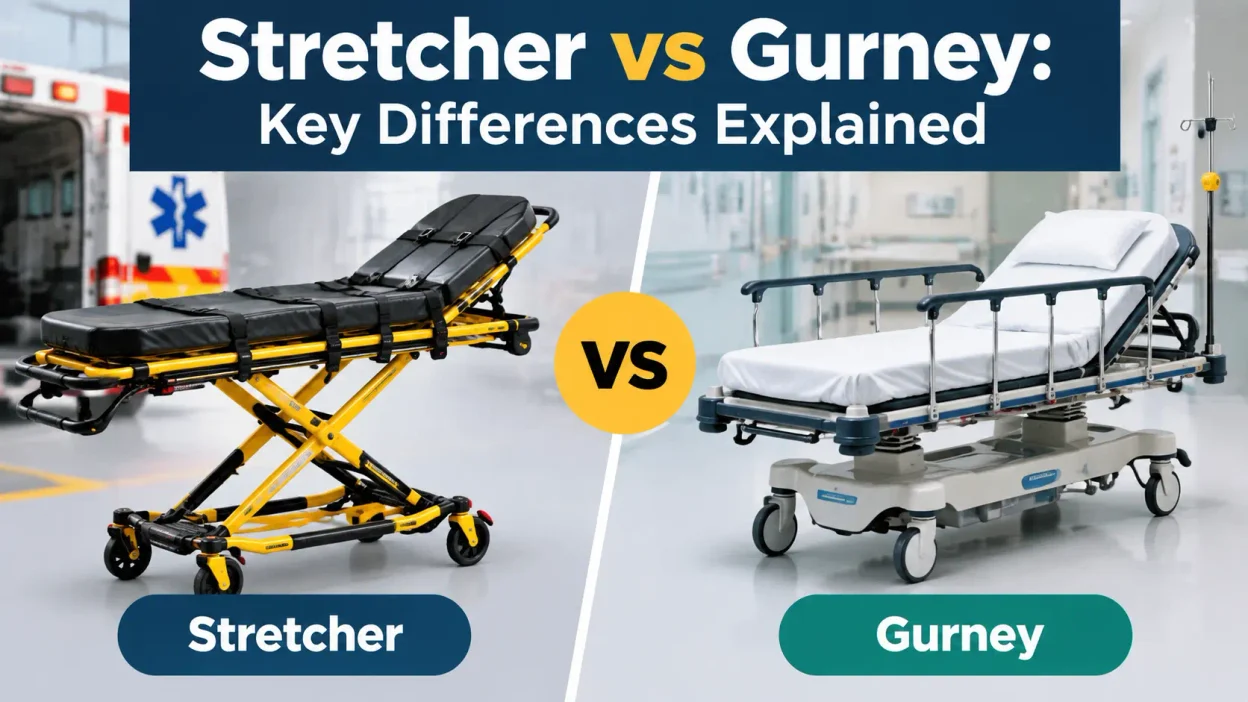
When people hear the words Stretcher vs Gurney, they often think they mean the same thing. In everyday American English, the two terms are frequently used interchangeably, especially when talking about emergency transportation in hospitals or ambulances.
However, there is a small difference. A stretcher is a general device used to carry or move injured, sick, or immobile people. A gurney usually refers to a wheeled stretcher designed for easier movement through hospitals, emergency rooms, and medical facilities.
Understanding the difference helps you use these terms more accurately, especially in healthcare, emergency services, and professional settings.
Quick Answer
A stretcher is any device used to transport a person who cannot walk, while a gurney is a type of stretcher with wheels and additional features used mainly in hospitals and emergency situations. In modern American English, many people use the two words as synonyms, but medical professionals often use “gurney” for a wheeled hospital transport bed.
What Is a Stretcher?
A stretcher is a medical transport device designed to move a person who is injured, unconscious, weak, or unable to walk safely.
Stretchers are commonly used by:
- Emergency medical technicians (EMTs)
- Paramedics
- Hospitals
- Military medical teams
- Rescue workers
The main purpose of a stretcher is transportation. It allows healthcare workers to move patients while reducing the risk of further injury.
A basic stretcher may be simple and lightweight, such as a foldable rescue stretcher used during outdoor emergencies. More advanced versions may include adjustable positions, safety straps, and support systems.
What Is a Gurney?
A gurney is a specialized type of stretcher that usually has wheels, adjustable sections, and a frame designed for hospital movement.
The term is commonly used in the United States, especially in:
- Emergency rooms
- Ambulances
- Operating areas
- Hospital corridors
A typical gurney allows medical staff to:
- Roll patients between departments
- Adjust the patient’s position
- Secure patients with safety rails or straps
- Transfer patients from one surface to another
Because of these features, gurneys are often more advanced than simple stretchers.
Stretcher vs Gurney: Main Differences
| Feature | Stretcher | Gurney |
|---|---|---|
| Meaning | General device for carrying patients | Wheeled medical stretcher |
| Wheels | May or may not have wheels | Usually has wheels |
| Main Use | Rescue, transport, emergency situations | Hospital and ambulance transport |
| Design | Can be simple or advanced | Usually more complex |
| Common Users | Rescue teams, EMTs, medical staff | Hospital workers and paramedics |
Are Stretchers and Gurneys the Same Thing?
In many situations, yes. Most Americans use the words stretcher and gurney to describe a device that carries patients while lying down.
For example, someone might say:
“The patient was taken to the emergency room on a gurney.”
Another person might say:
“The patient was moved using a stretcher.”
Both sentences can describe the same situation.
The difference appears mostly in professional medical language, where “stretcher” is the broader term and “gurney” usually describes a specific wheeled version.
When Do Medical Workers Use a Stretcher?
Healthcare workers may use a stretcher when a patient:
- Has a serious injury
- Cannot stand or walk
- Needs spinal support
- Requires emergency transportation
- Must be moved carefully
Examples include:
- A person injured in a car accident
- A patient rescued from a difficult location
- Someone needing transport during a medical emergency
When Do Medical Workers Use a Gurney?
A gurney is commonly used when patients need to move through a medical facility.
Common situations include:
- Moving a patient from an ambulance to an emergency room
- Transporting someone to surgery
- Moving patients between hospital departments
- Transferring someone after a medical procedure
The wheels and adjustable design make a gurney practical for indoor medical environments.
Why Do Americans Say “Gurney”?
The word gurney is especially common in American English. It became associated with wheeled hospital transport equipment over time.
In other English-speaking regions, people may prefer terms like:
- Trolley
- Hospital bed
- Wheeled stretcher
- Patient transport bed
The preferred word depends on location and healthcare system.
Stretcher vs Gurney: Which Word Should You Use?
For general conversations, either word is usually understood.
Use stretcher when:
- You mean any device used to carry a patient
- You are discussing rescue equipment
- You want the most general medical term
Use gurney when:
- You are describing a wheeled hospital transport device
- You are talking about emergency room equipment
- You are writing from a US healthcare perspective
Common Mistakes About Stretcher and Gurney
Mistake 1: Thinking every stretcher is a gurney
Not all stretchers are gurneys. A stretcher can be a simple carrying device without wheels.
Better understanding:
A gurney is one type of stretcher, but not every stretcher is a gurney.
Mistake 2: Assuming “gurney” is the official medical term everywhere
The word “gurney” is common in American English, but medical professionals may prefer more specific terms depending on the equipment.
Better understanding:
“Stretcher” is often the broader and more universally recognized term.
Mistake 3: Using the words differently in normal conversation
Most people will not notice a difference when someone says “stretcher” instead of “gurney.”
Better understanding:
The distinction matters more in professional healthcare settings than in everyday speech.
Related Terms
Hospital Bed
A hospital bed is designed for longer-term patient care rather than transportation.
Ambulance Cot
An ambulance cot is a wheeled stretcher specifically designed for emergency vehicles.
Wheelchair
A wheelchair helps people sit and move while conscious, unlike a stretcher or gurney, which is mainly for patients who must remain lying down.
Frequently Asked Questions
Is a gurney the same as a stretcher?
A gurney is a type of stretcher, but the terms are not always identical. A stretcher is any device used to move a patient, while a gurney usually refers to a wheeled hospital stretcher.
Do hospitals use stretchers or gurneys?
Hospitals commonly use both terms. Many hospitals use wheeled stretchers, which are often called gurneys in everyday American speech.
Is “gurney” an American word?
Yes, “gurney” is especially common in American English. Other countries may use different terms, such as trolley or wheeled stretcher.
Can a stretcher have wheels?
Yes. Some stretchers have wheels, while others are simple carrying devices. A wheeled stretcher is often considered a gurney.
Which is better: a stretcher or a gurney?
Neither is better because they serve different purposes. A gurney is useful for hospital transportation, while a stretcher can be used in a wider range of rescue and medical situations.
Conclusion
The difference between a stretcher and a gurney is mainly about design and usage. A stretcher is the broad term for equipment used to move patients, while a gurney usually refers to a wheeled stretcher used in hospitals and emergency care.
In everyday American conversation, the words often mean the same thing. However, understanding the distinction helps you communicate more clearly in medical, emergency, and professional settings.


