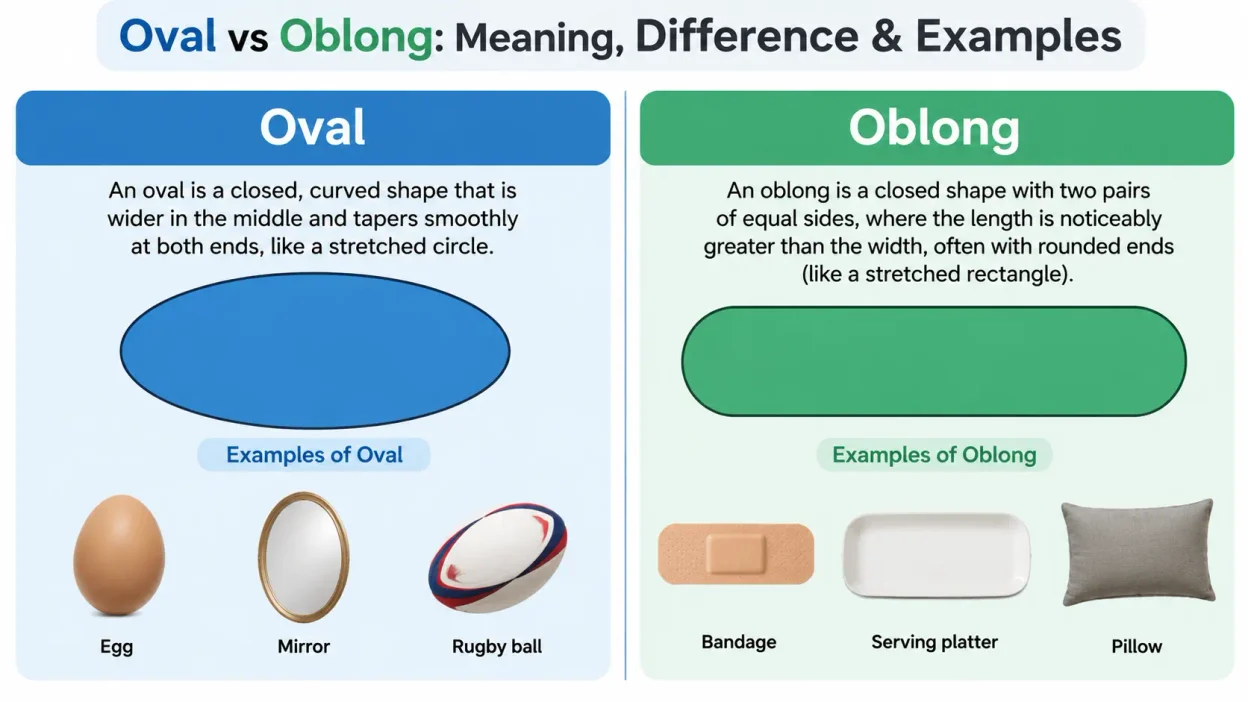
Oval vs Oblong are often used to describe long, rounded shapes, but they are not exactly the same. An oval is a smooth, symmetrical shape similar to an elongated circle, while an oblong is a stretched shape that is longer than it is wide and may have rounded or rectangular features.
In everyday conversation, people sometimes use these words interchangeably. However, they describe slightly different ideas depending on the context, especially in design, geometry, and everyday descriptions.
Quick Answer
An oval is a rounded shape with no corners, like an egg or a stretched circle. An oblong is a shape that is longer in one direction than the other and can look like an elongated rectangle or oval. Every oval can be considered elongated, but not every oblong shape is a true oval.
What Does Oval Mean?
Oval is an adjective and noun used to describe a rounded, egg-like shape.
An oval has:
- A curved outline
- No sharp corners
- A balanced, symmetrical appearance
- A shape created by stretching a circle
Common examples of oval shapes include:
- Eggs
- Oval mirrors
- Running tracks
- Some sports fields
- Oval jewelry designs
Example sentences:
- “She bought an oval dining table for the room.”
- “The artist painted an oval frame around the portrait.”
In geometry, an oval usually refers to a smooth closed curve that resembles a circle but is longer in one direction.
What Does Oblong Mean?
Oblong describes something that is longer than it is wide.
An oblong shape usually has:
- Greater length than width
- A stretched appearance
- Rounded or straight edges depending on the object
Examples of oblong objects:
- Rectangular phone screens
- Long tablets
- Some books
- Rectangular signs
Example sentences:
- “The room has an oblong table that fits eight people.”
- “The package arrived in an oblong box.”
The word oblong focuses more on proportion than a specific geometric shape.
Oval vs Oblong: Key Differences
| Feature | Oval | Oblong |
|---|---|---|
| Main idea | Rounded, stretched circle | Longer shape than width |
| Corners | No corners | May have rounded or straight edges |
| Symmetry | Usually symmetrical | Usually longer in one direction |
| Common examples | Egg, oval mirror, track | Book, table, box |
| Main focus | Curved appearance | Length-to-width ratio |
Difference Between Oval and Oblong in Simple Terms
The easiest way to remember the difference is:
- Oval = round but stretched
- Oblong = longer than it is wide
Imagine a circle being pulled from both sides. The result looks like an oval.
Now imagine a rectangle becoming longer while keeping its general shape. It becomes oblong.
Are Oval and Oblong the Same?
No, they are related but not identical.
An oval must have a smooth curved shape. An oblong only needs to be longer than it is wide.
For example:
- An egg shape is oval.
- A long rectangular table is oblong.
- A rounded rectangle may also be called oblong.
However, in casual speech, many people use “oval” and “oblong” to describe similar long shapes.
Oval Examples in Everyday Life
You can find oval shapes in many places:
1. Jewelry
Many rings and gemstones use oval designs because they create a longer appearance while keeping smooth curves.
2. Mirrors
Oval mirrors are common in homes because they provide a soft, decorative look.
3. Sports Areas
Some athletic tracks and fields have oval layouts.
4. Artwork
Artists often use oval frames and designs for portraits.
Oblong Examples in Everyday Life
Oblong shapes appear in many practical objects:
1. Furniture
An oblong dining table is longer than it is wide and provides more seating space.
2. Books
Many books have an oblong appearance because their length exceeds their width.
3. Packaging
Boxes and containers are often described as oblong when they have a stretched shape.
4. Rooms
A long rectangular room may be called oblong.
When Should You Use Oval?
Use oval when you want to emphasize a rounded, curved shape.
Correct examples:
- “The logo has an oval design.”
- “The necklace has an oval gemstone.”
- “The window is oval-shaped.”
Avoid using oval for objects with obvious straight sides and corners.
When Should You Use Oblong?
Use oblong when the main feature is that something is longer than it is wide.
Correct examples:
- “The table has an oblong shape.”
- “The room is narrow and oblong.”
- “The container is oblong.”
Oblong is especially useful when describing size and proportion.
Common Mistakes
Mistake 1: Calling every long shape oval
Incorrect:
- “The rectangular box is oval.”
Better:
- “The rectangular box is oblong.”
Why: The box has straight edges and corners, so it is not a true oval.
Mistake 2: Using oblong only for curved shapes
Incorrect:
- “An oblong shape must always be rounded.”
Better:
- “Oblong describes something longer than wide, whether the edges are curved or straight.”
Oval vs Oblong in Design and Fashion
In design, the difference can affect appearance.
Oval designs often feel:
- Soft
- Elegant
- Natural
- Smooth
Oblong designs often feel:
- Longer
- More spacious
- Functional
- Structured
For example, an oval mirror creates a softer decorative style, while an oblong mirror may emphasize height or width.
Related Terms
Ellipse
An ellipse is a mathematical shape closely related to an oval. In everyday language, people often use oval and ellipse similarly, although geometry makes more precise distinctions.
Rectangular
A rectangle has four straight sides and four corners. Some rectangles can be oblong because they are longer than they are wide.
Rounded Rectangle
A rounded rectangle has straight sides with curved corners. It may sometimes be described as oblong.
Frequently Asked Questions
Is an oval the same as an oblong?
No. An oval is a smooth, rounded shape similar to a stretched circle. An oblong describes anything longer than it is wide and may include shapes with straight sides.
Is an egg oval or oblong?
An egg is usually described as oval because it has a curved, rounded shape. Some eggs may look slightly oblong because they are longer than they are wide.
Can a rectangle be oblong?
Yes. A rectangle can be oblong if its length is greater than its width.
Is an oval always longer than it is wide?
Not always. An oval is usually longer in one direction, but the word mainly describes its rounded shape rather than a strict measurement.
Which word should I use for a table shape?
Use “oval” for a fully rounded table with no corners. Use “oblong” for a long table that may have straight sides or a stretched design.
Conclusion
The difference between oval and oblong comes down to shape and proportion. An oval describes a smooth, rounded form like a stretched circle, while an oblong describes something that is longer than it is wide.
For everyday use, choose oval when the curved appearance matters and choose oblong when the length and stretched shape are the main focus.