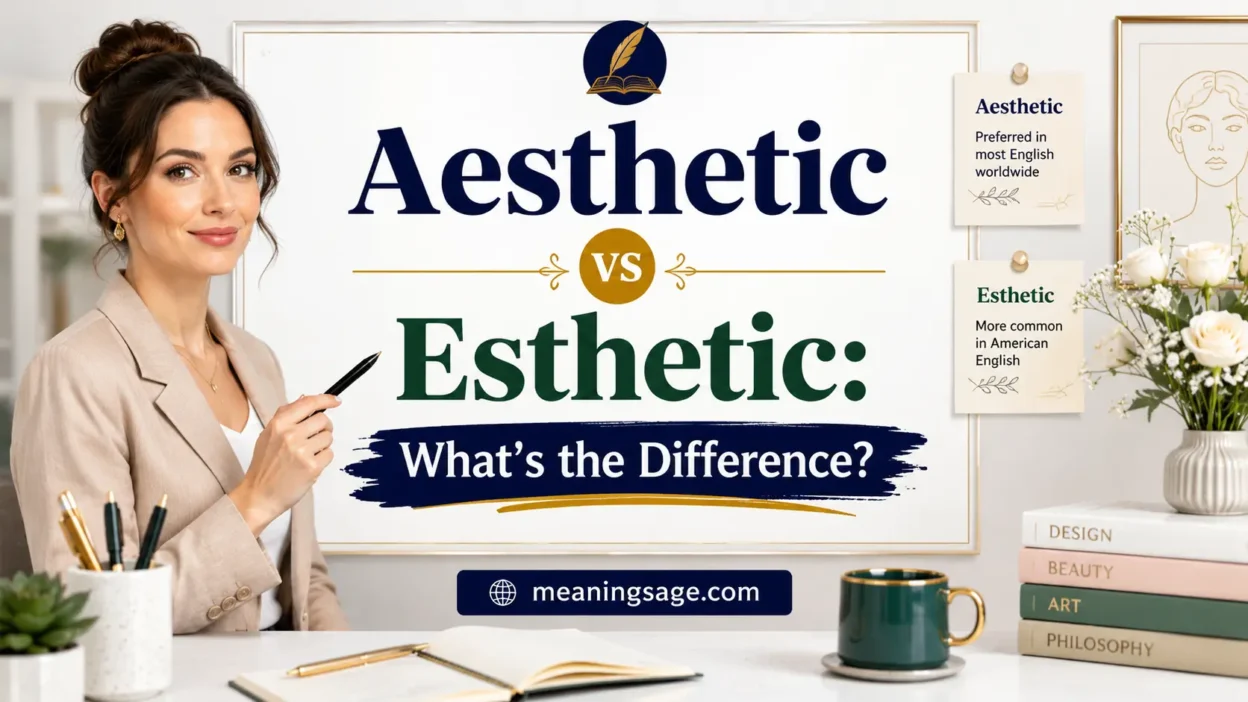
Aesthetic and esthetic are both correct spellings, and they generally mean the same thing. The main difference is spelling and usage preference, not definition.
For most American English writing, aesthetic is the safer and more familiar choice. Esthetic is also recognized in the United States, especially in beauty and skincare contexts — Merriam-Webster lists “esthetic” as a US variant of “aesthetic,” while Cambridge identifies it as a US spelling of the same word. Understanding when each spelling appears can help you choose the version that sounds most natural for your context.
Quick Answer
Aesthetic and esthetic mean the same thing. Both can refer to beauty, artistic appearance, visual style, or the principles of art and beauty. In general US writing, aesthetic is usually the best default choice. Esthetic is a valid American variant and often appears in professional skincare terms such as “esthetician” and “esthetics.”
Aesthetic vs Esthetic at a Glance
| Word | Meaning | Correct? | Best Use |
| Aesthetic | Related to beauty, art, appearance, or visual style | Yes | Best general-purpose spelling |
| Esthetic | Same meaning as aesthetic | Yes | US variant; also seen in skincare |
| Aesthetics | Principles or qualities of beauty and artistic taste | Yes | Art, philosophy, design, general writing |
| Esthetics | Variant of aesthetics | Yes | Often seen in US beauty and skincare terminology |
The important point is that aesthetic and esthetic aren’t two different concepts — the spelling changes, but the basic meaning doesn’t.
What Does Aesthetic Mean?
As an adjective, aesthetic describes something connected with beauty, appearance, art, taste, or what’s pleasing to the senses: “the designer made several aesthetic improvements to the room,” “the building combines practical and aesthetic features.” Merriam-Webster defines the adjective in senses relating to aesthetics or beauty, artistic qualities, attractive appearance, and treatments intended to improve appearance.
Aesthetic can also function as a noun, where it means a particular style, artistic approach, or idea of what looks pleasing: “the café has a warm, vintage aesthetic,” “minimalism is central to the brand’s aesthetic.” This noun use is especially handy when talking about fashion, interior design, photography, and branding — Merriam-Webster recognizes this sense as a particular approach to beauty or what is pleasing to the senses.
What Does Esthetic Mean?
Esthetic is an alternative spelling of aesthetic: “the architect considered both practical and esthetic concerns,” “the room’s esthetic reflects a minimalist approach.” These sentences carry essentially the same meaning if you swap in “aesthetic” instead.
Cambridge specifically describes esthetic as a US spelling of aesthetic, and Merriam-Webster also recognizes esthetic as a US variant of the adjective and as a less common variant of the noun.
Is Aesthetic or Esthetic Correct in American English?
Both are correct in American English, but that doesn’t mean you should choose between them randomly. For general writing, aesthetic is the clearer default, since major American dictionaries use it as their primary headword while listing esthetic as a variant. Use aesthetic in sentences like “the website needs a cleaner aesthetic” or “we made aesthetic changes to the kitchen.” Using esthetic in these sentences wouldn’t be incorrect, but aesthetic is generally the safer choice when you have no specific reason to pick the variant.
Is Esthetic the American Spelling of Aesthetic?
It’s more accurate to say esthetic is an American variant, rather than saying Americans always spell the word esthetic. Cambridge labels esthetic as a US spelling, while Merriam-Webster lists aesthetic as the main form and notes esthetic as a US variant — meaning both forms genuinely exist in American English side by side.
So this rule is too simple: “British English uses aesthetic, American English uses esthetic.” A better rule is: general English uses aesthetic, American English uses either aesthetic or esthetic, and the safest default overall is aesthetic.
Why Is Esthetic Common in Skincare?
You’ll likely encounter esthetic, esthetics, and esthetician more often when reading about professional skincare. California’s Board of Barbering and Cosmetology, for example, uses “esthetics” for professional skincare practices and “estheticians” for licensed practitioners, and the US Bureau of Labor Statistics refers to state-approved “esthetician” programs when discussing training for skincare specialists — think esthetician training, medical esthetics, or licensed esthetician.
That said, spelling isn’t completely uniform across every US jurisdiction. Massachusetts, for example, uses forms such as “aesthetics” and “aesthetician” in some official licensing material. If you’re writing about a professional license, school, or organization, use the spelling that entity officially uses rather than defaulting automatically.
Aesthetic vs Esthetic in Everyday Writing
For everyday writing, aesthetic is usually the simplest choice. “The restaurant has a modern aesthetic” reads as the better general-purpose option, though “the restaurant has a modern esthetic” is also possible without changing the meaning. The same goes for design writing — “the designer balanced function with aesthetic appeal” versus “esthetic appeal” — and for beauty treatments, where both “aesthetic treatment” and “esthetic treatment” may appear. Merriam-Webster specifically recognizes “aesthetic” in expressions involving treatments and procedures intended to enhance appearance.
Aesthetic as a Modern Style Word
Today, aesthetic isn’t limited to philosophy or formal discussions of art. It commonly describes the overall look, mood, or visual identity of something — a minimalist aesthetic, a vintage aesthetic, a dark academic aesthetic, a beach-inspired aesthetic. In these examples, “aesthetic” means something close to visual style or artistic character. Merriam-Webster recognizes the noun as a particular conception or approach to beauty and notes the word’s broader use in design and visual culture generally.
Do Aesthetic and Esthetic Have Different Pronunciations?
Usually, no. In American English, aesthetic is commonly pronounced approximately “es-THET-ik,” and the alternate spelling esthetic represents the same word without creating a separate pronunciation or meaning. Merriam-Webster gives the pronunciation /es-ˈthe-tik/ for its main entry while listing esthetic as a spelling variant.
Aesthetic vs Aesthetics
Be careful not to confuse aesthetic with aesthetics. Aesthetic can be an adjective (“the garden has aesthetic value”) or a noun referring to a particular style (“I like the hotel’s aesthetic”). Aesthetics, meanwhile, can refer to artistic or beautiful qualities collectively (“the aesthetics of the building are impressive”) or to the branch of philosophy concerned with beauty, art, and taste — Merriam-Webster recognizes both senses. The variant “esthetics” can be used in corresponding contexts, particularly in American professional skincare terminology.
Aesthetic vs Ascetic
Another word that can cause confusion is ascetic. Although “aesthetic” and “ascetic” look somewhat similar, they have entirely different meanings. Aesthetic relates to beauty, art, taste, or appearance (“the hotel has strong aesthetic appeal”), while ascetic relates to strict self-discipline and avoiding physical comforts, often for religious or spiritual reasons (“he lived an ascetic lifestyle”). Merriam-Webster treats them as distinct words despite their similar appearance on the page.
Common Mistakes With Aesthetic and Esthetic
Thinking esthetic is a misspelling. It isn’t — esthetic is a recognized variant of aesthetic, particularly in American English.
Assuming all Americans use esthetic. They don’t have to. Aesthetic is fully correct in US English; esthetic is simply another accepted variant.
Switching spellings unnecessarily within the same piece. Avoid writing something like “the company’s aesthetic changed because its designers wanted a different esthetic.” Unless there’s a specific reason for the change, pick one spelling and stay consistent — “the company’s aesthetic changed because its designers wanted a different aesthetic” reads much cleaner.
Confusing aesthetic with beautiful. Aesthetic doesn’t always mean simply “beautiful.” Something can have a recognizable aesthetic without everyone considering it attractive — the word may describe a visual style or artistic approach rather than directly saying something is beautiful.
Which Spelling Should You Use?
For most situations, choose aesthetic — for academic writing, art and design, architecture, fashion, photography, social media, branding, and everyday descriptions of visual style. Use esthetic when it’s the established spelling used by a particular organization, profession, school, or licensing body instead.
The easiest rule to remember: if you’re unsure, use aesthetic.
Frequently Asked Questions
Is aesthetic or esthetic correct? Both are correct. Aesthetic is the main spelling used by major dictionaries, while esthetic is recognized as a US variant.
Do aesthetic and esthetic mean the same thing? Yes. They generally refer to the same ideas involving beauty, artistic appearance, taste, design, or visual style. The difference is mainly spelling rather than meaning.
Is esthetic only American English? Esthetic is especially associated with American English, but it would be misleading to assume Americans must use it. Aesthetic is also standard and fully correct in the United States.
Why do estheticians spell it without an A? The spelling “esthetician” is common in the US skincare profession and appears in federal and state occupational or licensing material. However, some authorities also use “aesthetician,” so professional spelling can vary by jurisdiction.
Can aesthetic be a noun? Yes. As a noun, aesthetic can describe a particular visual style or approach to beauty, as in “a minimalist aesthetic.”
Is it aesthetic or aesthetics? Use “aesthetic” when describing something or referring to a particular style: “a modern aesthetic.” Use “aesthetics” when discussing artistic qualities collectively or the philosophical study of beauty and art.
Is esthetic a typo? No. Esthetic is a legitimate spelling recognized in American English. It shouldn’t automatically be corrected as an error.
Conclusion
The difference between aesthetic and esthetic is mainly a matter of spelling. Both forms can relate to beauty, visual appearance, artistic taste, or design, and both are recognized in American English.
For general writing, aesthetic is the best default. Choose esthetic when it matches established professional terminology or the official spelling used by a particular organization. Most importantly, stay consistent within the same piece of writing.
Simple rule: when in doubt, choose aesthetic.