Many English learners confuse “In Tow or In Toe” because they sound almost identical when spoken. However, only one of these expressions is a standard English phrase.
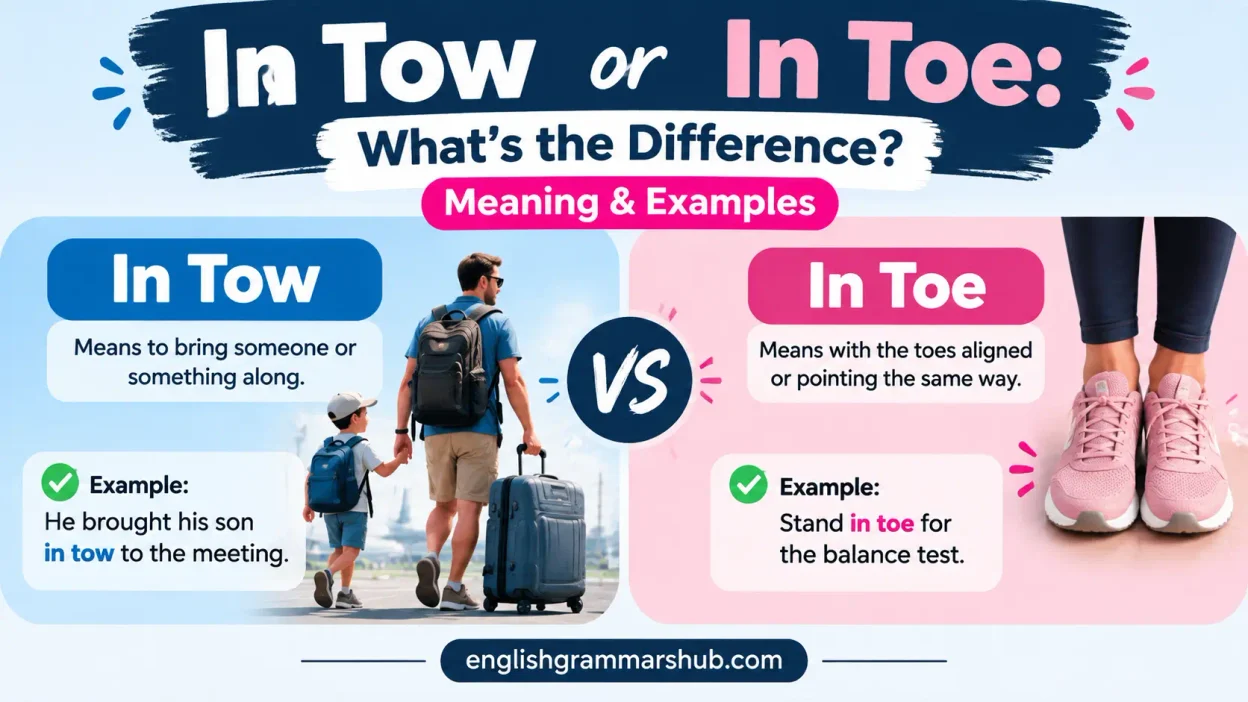
The correct phrase is “in tow.” It means that someone or something is being brought along, followed, or accompanied by another person or thing.
“In toe” is usually incorrect when used as a phrase. The word toe refers to one of the digits on your foot, so it does not have the same meaning as tow.
Quick Answer
“In tow” is the correct expression. It means someone or something is accompanying another person, often while being guided, carried, or pulled along. For example, “She went shopping with her two children in tow” means her children came with her.
“In toe” is not a correct phrase for this meaning. It only relates to a physical toe on your foot.
What Does “In Tow” Mean?
The phrase “in tow” means being accompanied by someone or something that follows along with another person.
It is often used when a person has someone else with them, especially children, pets, friends, or extra responsibilities.
Examples:
- She traveled across the country with her dog in tow.
- The manager arrived with several assistants in tow.
- He went to the store with his young son in tow.
In these examples, the person or thing “in tow” is coming along with someone else.
Why Is It “In Tow”?
The word tow comes from the idea of pulling something behind you. A vehicle can tow a trailer, meaning it pulls the trailer along.
Over time, the expression “in tow” developed a broader meaning: something or someone being brought along.
The phrase does not always mean physical pulling. It often describes simply having someone accompany you.
What Does “In Toe” Mean?
“In toe” is not a standard English expression when you mean “coming along with someone.”
The word toe has a completely different meaning. It refers to one of the small digits at the end of your foot.
Examples:
- I hurt my big toe while running.
- She painted her toenails a bright color.
- The child stood on his toes to reach the shelf.
Because toe refers to a body part, it does not work in the expression “in tow.”
In Tow vs In Toe: Key Difference
| Phrase | Meaning | Correct Usage |
|---|---|---|
| In tow | Accompanied by someone or something | Correct |
| In toe | Related to a toe on the foot | Usually incorrect as a phrase |
How to Use “In Tow” Correctly
“In tow” usually appears after a person or thing that is being accompanied.
Common patterns:
Person + with + someone/something + in tow
Examples:
- The mother walked into the restaurant with three children in tow.
- The traveler arrived with heavy luggage in tow.
- The celebrity entered the event with photographers in tow.
It can also describe something that follows a larger movement or action:
- The company expanded into new markets, bringing new challenges in tow.
Common Mistake: Writing “In Toe”
Incorrect:
She went to the meeting with her assistant in toe.
Correct:
She went to the meeting with her assistant in tow.
The assistant is accompanying her, so the correct word is tow, not toe.
Memory Trick: Tow Means Follow or Pull
A simple way to remember the difference:
- Tow = pull or bring along
- Toe = part of your foot
If someone is coming with you, they are in tow.
If you are talking about your foot, you are talking about a toe.
Similar Expressions to “In Tow” In Tow or In Toe
Depending on the situation, you can replace “in tow” with:
- along with
- accompanied by
- together with
- with someone following
- bringing along
Examples:
- She arrived with her children in tow.
- She arrived accompanied by her children.
- She arrived with her children along with her.
Frequently Asked Questions
Is “in toe” ever correct?
Yes, but only when talking about an actual toe or something related to the foot. It is not correct as a replacement for “in tow.”
Does “in tow” mean someone is following behind?
Usually, yes. It describes someone or something accompanying another person. It does not always mean directly walking behind them.
Can I use “in tow” for objects?
Yes. “In tow” can describe people, animals, vehicles, or objects that are being brought along.
Example:
“The truck arrived with a trailer in tow.”
Is “in tow” formal or informal?
“In tow” is a common English expression used in both casual and formal writing. It is widely understood by American English speakers.
What is the difference between tow and toe?
Tow means to pull or bring something along. Toe is a part of the foot. They sound the same but have different meanings.
Conclusion
The correct phrase is “in tow,” not “in toe,” when you mean someone or something is accompanying another person. The confusion happens because both words sound alike, but their meanings are completely different.
Remember: tow means bring along, while toe means a part of your foot.